
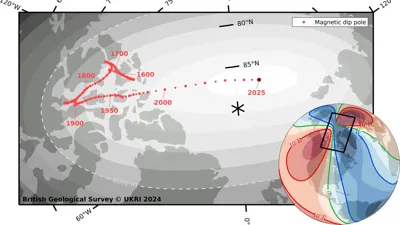
The Accelerated Shift of Earth's Magnetic North Pole: Causes and Implications
| Category | Details |
|---|---|
| Why in News? | The Magnetic North Pole is shifting at an accelerated pace, moving closer to Siberia and drifting toward Russia, affecting navigation, wildlife, and communication systems. |
| About Earth's Magnetic Poles | The magnetic poles are generated by the movement of molten iron and nickel in Earth's outer core and are constantly shifting, unlike the fixed geographic poles. |
| Discovery | Located in 1831 by James Clark Ross near Canada's Arctic islands. It has been continuously monitored since then. |
| Historical Movement | The Magnetic North Pole has shifted 400+ km from Canada to Russia over the past 100 years, influenced by Earth's core dynamics. |
| Tracking System | The World Magnetic Model (WMM) is used to track the pole's movement and is updated every five years for accurate navigation. |
| Causes of the Shift | - Core Fluid Dynamics: Molten iron & nickel movement in the outer core. - Geomagnetic Anomalies: Variations like the South Atlantic Anomaly affect the field. - Magnetic Reversal Cycle: Historical reversals occur every 200,000-300,000 years; the last was 780,000 years ago. |
| Earth's Magnetic Field & Magnetosphere | - The magnetic field is generated in the outer core. - The magnetosphere protects Earth from solar winds and cosmic radiation. - Variations in solar activity can cause geomagnetic storms affecting satellites and power grids. |
| Implications of the Shift | - Navigation Systems: Aviation, maritime, and military operations need frequent updates to the WMM. - Animal Migration: Birds & marine animals relying on magnetic navigation may face disruptions. - Communication & Satellites: Increased vulnerability to solar storms affecting GPS and power grids. - Scientific Research: Helps study geodynamo processes for better predictions of geomagnetic changes. |