
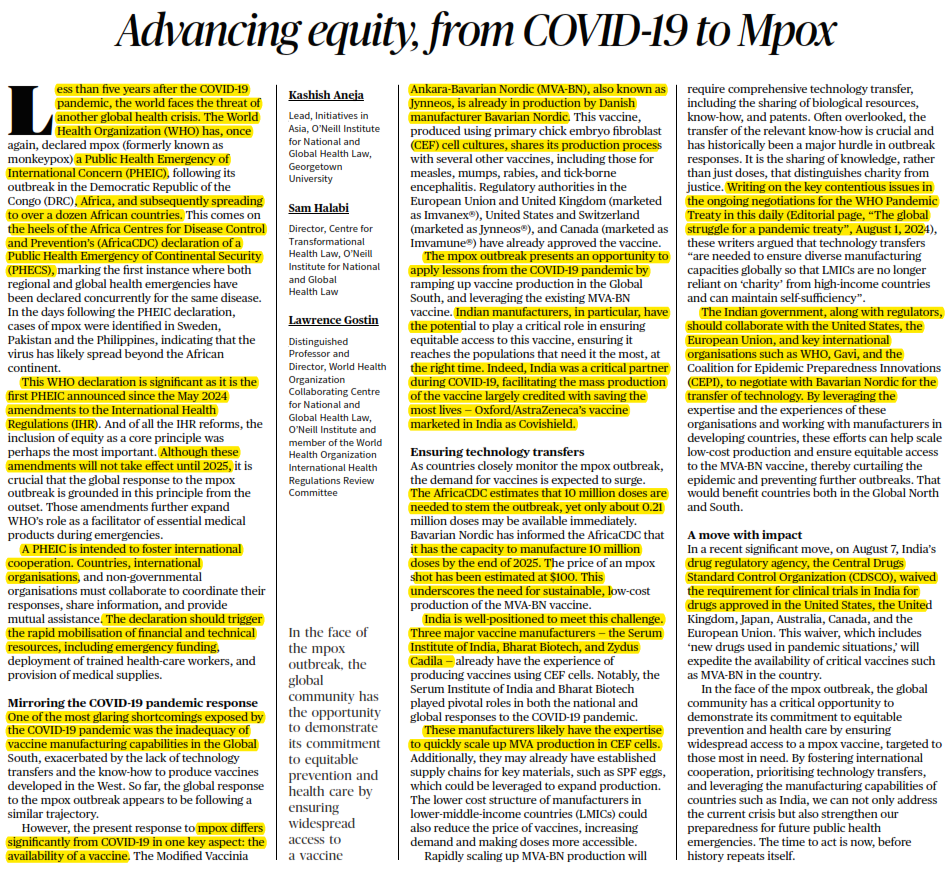
Advancing equity,from COVID-19 to Mpox
- Less than five years after the COVID-19 pandemic, the world is facing a new global health threat with the World Health Organization (WHO) declaring mpox (formerly known as monkeypox) a Public Health Emergency of International Concern (PHEIC).
- This declaration follows outbreaks in the Democratic Republic of the Congo (DRC) and several other African countries, with cases now identified in Sweden, Pakistan, and the Philippines.
- This is a significant moment, as it is the first PHEIC declared since the amendments to the International Health Regulations (IHR) in May 2024, which emphasize equity as a core principle.
The Importance of International Cooperation:
- A PHEIC is intended to encourage international cooperation among countries, organizations, and non-governmental bodies. It prompts the rapid mobilization of resources, including financial aid, technical support, and medical supplies..
Lessons from COVID-19: Vaccine Production and Equity:
- The COVID-19 pandemic exposed major gaps in global vaccine production capabilities, particularly in the Global South, where technology transfers and know-how were severely lacking.
- This has led to a similar trajectory for the mpox outbreak, though with a crucial difference: the availability of a vaccine.
- The Modified Vaccinia Ankara-Bavarian Nordic (MVA-BN), also known as Jynneos, is a vaccine already in production by Bavarian Nordic.
- It has been approved in various countries, including the European Union, the United Kingdom, the United States, Switzerland, and Canada.
- This vaccine presents a unique opportunity to address the current outbreak effectively and apply the lessons learned from the COVID-19 pandemic.
Expanding Vaccine Production in the Global South:
- Given the estimated need for 10 million doses of the MVA-BN vaccine, with only about 0.21 million doses available immediately, there is an urgent need for increased production.
- Bavarian Nordic has indicated it can produce 10 million doses by the end of 2025, but the price of $100 per dose underscores the need for more affordable production methods.
- India, with its robust vaccine manufacturing capabilities, is well-positioned to meet this challenge. Major Indian manufacturers like the Serum Institute of India, Bharat Biotech, and Zydus Cadila have extensive experience with vaccine production and could play a pivotal role in scaling up MVA-BN production.
- These manufacturers have the expertise and infrastructure to leverage existing supply chains and reduce production costs, making vaccines more accessible.
The Need for Technology Transfers:
- To maximize production and ensure equitable access, comprehensive technology transfers are essential. This involves sharing biological resources, technical know-how, and patents.
- Historically, the transfer of knowledge has been a major hurdle in pandemic responses. Addressing this issue is crucial for achieving global self-sufficiency and avoiding reliance on high-income countries.
- The Indian government, along with international organizations such as WHO, Gavi, and the Coalition for Epidemic Preparedness Innovations (CEPI), should negotiate with Bavarian Nordic to facilitate technology transfers.
- This collaboration can help expand low-cost production and ensure that the MVA-BN vaccine reaches those in greatest need.
Recent Developments in India:
- In a positive development, India’s drug regulatory agency, the Central Drugs Standard Control Organization (CDSCO), recently waived the requirement for clinical trials in India for drugs approved in several other countries.
- This waiver, applicable to new drugs used in pandemic situations, will expedite the availability of critical vaccines like MVA-BN in India.