
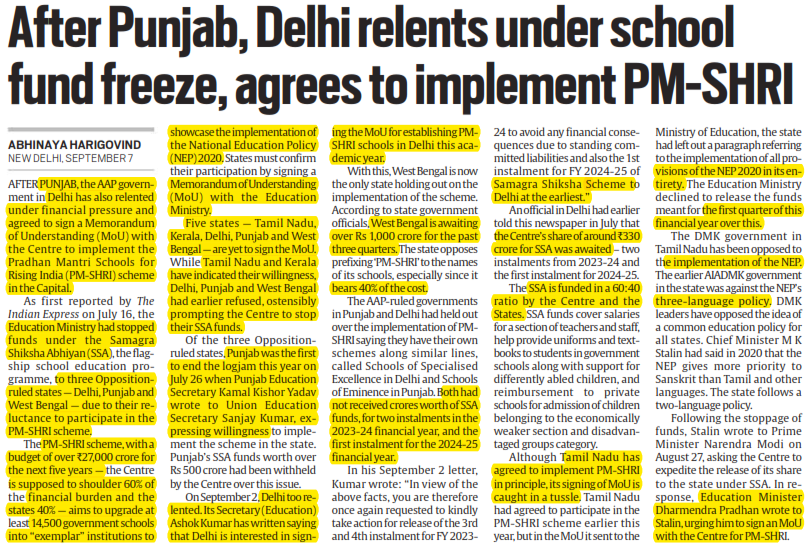
After Punjab, Delhi relents under school fund freeze, agrees to implement PM-SHRI
- Tamil Nadu and Kerala have indicated their willingness, Delhi, Punjab and West Bengal had earlier refused, ostensibly prompting the Centre to stop their SSA funds.
Highlights:
- The AAP-led Delhi government, under financial pressure, has agreed to sign a Memorandum of Understanding (MoU) with the Centre to implement the Pradhan Mantri Schools for Rising India (PM-SHRI) scheme.
- This decision follows a similar move by the Punjab government, which was the first to relent earlier this year. The scheme, aimed at upgrading government schools, has faced opposition from several states, primarily due to political disagreements.
Background: Delay in SSA Funds:
- The Ministry of Education had halted funds under the Samagra Shiksha Abhiyan (SSA) to three Opposition-ruled states—Delhi, Punjab, and West Bengal—due to their reluctance to implement the PM-SHRI scheme.
- SSA is a flagship school education program that funds crucial elements of public schooling such as teacher salaries, student uniforms, textbooks, and support for differently-abled children.
- The withheld SSA funds significantly impacted the education budget in these states.
Overview of the PM-SHRI Scheme:
- The PM-SHRI scheme, with a budget exceeding ₹27,000 crore over five years, aims to upgrade at least 14,500 government schools into “exemplar” institutions aligned with the National Education Policy (NEP) 2020.
- The funding model is shared, with 60% of the financial burden borne by the Centre and 40% by the states. For states to access these funds, they must sign an MoU with the Centre confirming their participation in the scheme.
- Delhi, along with West Bengal and Punjab, initially resisted signing the MoU due to pre-existing state initiatives such as Schools of Specialised Excellence in Delhi and Schools of Eminence in Punjab.
- However, after Punjab relented on July 26, Delhi followed suit on September 2, requesting the release of SSA funds.
Punjab’s Early Compliance and SSA Fund Blockage:
- Punjab was the first of the Opposition-ruled states to comply, with the Punjab Education Secretary expressing willingness to implement the scheme on July 26. Punjab’s SSA funds, amounting to over ₹500 crore, had been withheld over this issue.
- Following this, the Delhi Education Secretary wrote to the Centre, signaling Delhi's intent to sign the MoU and requesting the release of over ₹330 crore in SSA funds.
West Bengal’s Resistance and Ongoing Issues:
- West Bengal remains the only state resisting the implementation of the PM-SHRI scheme. State officials argue that since West Bengal bears 40% of the costs, they oppose prefixing "PM-SHRI" to the names of their schools.
- The state is also awaiting over ₹1,000 crore in SSA funds. The delay in signing the MoU has caused significant financial strain on the state's education budget.
Challenges in Tamil Nadu:
- Although Tamil Nadu has indicated its willingness to participate in the PM-SHRI scheme, the state's signing of the MoU is stalled due to disagreements over the National Education Policy (NEP) 2020.
- Tamil Nadu's government, led by the DMK, has consistently opposed several provisions of the NEP, particularly the three-language policy.
- The Centre declined to release SSA funds for Tamil Nadu after the state omitted a key paragraph related to NEP implementation in the draft MoU.
- In response to the Centre's halt in SSA funds, Tamil Nadu Chief Minister M.K. Stalin wrote to Prime Minister Narendra Modi on August 27, requesting the release of SSA funds. Union Education Minister Dharmendra Pradhan responded, urging the state to sign the MoU to resolve the issue.
Prelims Takeaways:
- Samagra Shiksha Abhiyan
- National Education Policy (NEP)