
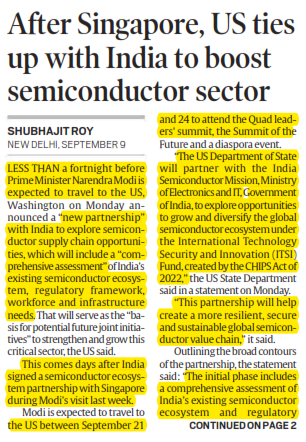
After Singapore, US ties up with India to boost semiconductor sector
- Washington on Monday announced a “new partnership” with India to explore semiconductor supply chain opportunities
Highlights:
- Ahead of Prime Minister Narendra Modi’s visit to the US, a new partnership between India and the US has been announced to explore semiconductor supply chain opportunities.
- The collaboration will focus on assessing India’s current semiconductor ecosystem and setting the stage for future joint initiatives to strengthen the sector. This announcement comes shortly after India signed a similar semiconductor partnership with Singapore.
Partnership Goals:
- The US Department of State will collaborate with India’s Semiconductor Mission under the Ministry of Electronics and IT.
- The partnership will be funded by the International Technology Security and Innovation (ITSI) Fund, which was created by the CHIPS Act of 2022. The first step is a comprehensive assessment of India’s:
- Semiconductor ecosystem.
- Regulatory framework.
- Workforce and infrastructure needs.
- Key Indian stakeholders, including state governments and private firms, will contribute to this assessment, forming the basis for future initiatives.
Importance of Semiconductors:
- Semiconductors are critical in a wide array of industries, from vehicles to medical devices and consumer electronics. The partnership aims to create a resilient, secure, and sustainable global semiconductor value chain, essential to the ongoing global digital transformation.
The CHIPS Act and US Efforts:
- The CHIPS Act, signed by US President Joe Biden in 2022, aims to bring semiconductor manufacturing back to the US.
- The act provides $500 million through the ITSI Fund to support secure semiconductor supply chains and related technology initiatives in partnership with global allies.
- The US's share of semiconductor production has decreased from 40% in 1990 to 12%, with Taiwan now producing over 60% of the world’s semiconductors.
Geostrategic and Economic Significance:
- India’s semiconductor partnerships with the US and Singapore have significant geo-strategic and economic importance.
- Global supply chains have been disrupted due to COVID-19 and geopolitical tensions involving China and Taiwan. Strengthening India’s semiconductor capabilities is essential for reducing reliance on a small number of countries dominating the chip industry.
India’s Semiconductor Mission:
- India launched its Semiconductor Mission in 2021 with a ₹76,000 crore incentive scheme to develop a domestic chip manufacturing ecosystem. Key developments include:
- Approval of ₹1.26 lakh crore worth of investments in semiconductor projects.
- A collaboration between the Tata Group and Taiwan’s Powerchip Semiconductor Manufacturing Corporation (PSMC) to establish a semiconductor fabrication plant in Gujarat.
Prelims takeaways:
- International Technology Security and Innovation (ITSI) Fund
- CHIPS Act