
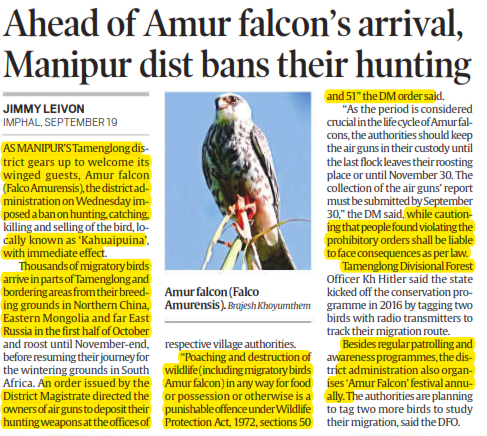
Ahead of Amur falcon's arrival, Manipur dist bans their hunting
- An order issued by the District Magistrate directed the owners of air guns to deposit their hunting weapons at the offices of respective village authorities.
Highlights:
- As Amur falcons (Falco Amurensis) prepare to arrive in Manipur's Tamenglong district, the local administration has imposed a ban on hunting, catching, killing, and selling of the migratory bird, locally known as ‘Kahuaipuina’.
- The birds migrate from their breeding grounds in Northern China, Eastern Mongolia, and Far East Russia, roosting in the region from October to November before continuing to their wintering grounds in South Africa.
- The District Magistrate of Tamenglong issued an order prohibiting any activities that harm the Amur falcons, in accordance with the Wildlife Protection Act of 1972.
- Sections 50 and 51 of the Act make the poaching or destruction of wildlife, including migratory birds, a punishable offense. The order further directed the deposit of air guns—used in hunting—at village offices until November 30 to ensure the safety of the birds.
Conservation Efforts:
- Since 2016, the state has actively participated in Amur falcon conservation. Authorities have employed measures such as tagging birds with radio transmitters to track their migration routes, regular patrolling, and conducting awareness programmes. The district also celebrates the ‘Amur Falcon’ festival annually to promote conservation efforts.
- According to Kh Hitler, Tamenglong Divisional Forest Officer, two more birds are set to be tagged this year for further study of their migration patterns. Through these measures, the administration hopes to protect these falcons and promote ecological balance.
Significance of Amur Falcons:
- Amur falcons are among the longest-distance migratory birds and rely on stopover points like Tamenglong to rest and refuel. Their migration is not only a spectacle but also crucial for maintaining global biodiversity.
- The ban and conservation measures reflect the district’s commitment to preserving its unique natural heritage.
Prelims Takeaways:
- Wildlife Protection Act, 1972