
All the BRICS is a stage
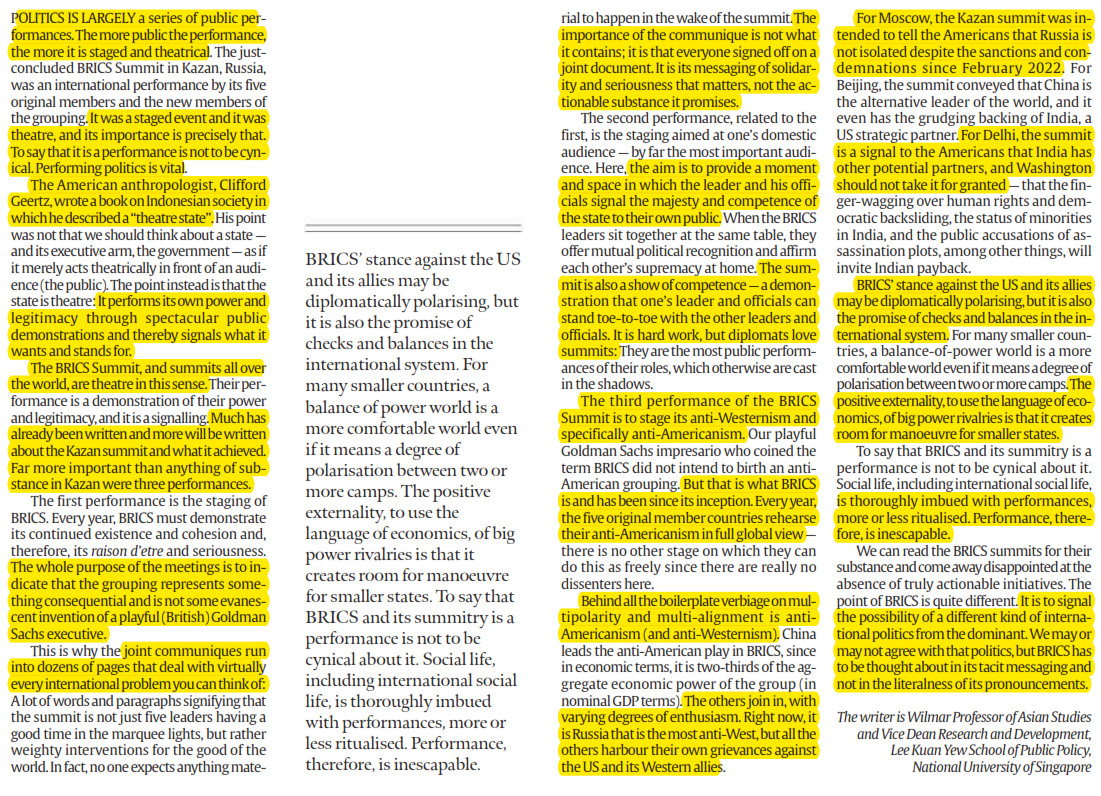
- The notion that politics functions as a series of public performances is compellingly illustrated by the recent BRICS Summit in Kazan, Russia. This gathering of the original BRICS members alongside new entrants was not just a diplomatic meeting; it was a carefully staged theatrical event intended to convey power, legitimacy, and shared identity among its participants.
- The summit's significance lies not in the tangible outcomes it produced, but in the performances themselves, reflecting the underlying dynamics of international relations.
The Performative Nature of Political Summits
Staging BRICS:
- Each BRICS Summit serves to reaffirm the group’s relevance and cohesiveness in the global political landscape. In a world where many regional coalitions can falter, demonstrating that BRICS is not merely a fleeting idea birthed by a financial analyst is crucial.
- The extensive joint communiques that emerge from these meetings, filled with discussions on numerous international issues, symbolize this intent. While these documents might not lead to significant actionable initiatives, their very existence signifies a collective stance—an assertion of unity and purpose among the member states.
Domestic Signalling:
- The summit's performances also cater to domestic audiences, showcasing each leader’s capability and reinforcing their authority. When BRICS leaders come together, it’s more than a diplomatic photo op; it’s an opportunity for them to project strength and competence to their constituents.
- This display of solidarity among leaders not only bolsters their political standing at home but also communicates a message of international respect and recognition, important for their domestic narratives.
Anti-Western Sentiment:
- The BRICS Summit also functions as a platform for expressing anti-Western, particularly anti-American sentiments. Although initially unintentional, the group has become a focal point for countries to voice their grievances against Western hegemony. China, holding a dominant economic position within BRICS, often takes the lead in this narrative, with other members joining in to varying degrees.
- For Russia, the summit was a chance to assert that it remains relevant on the global stage despite sanctions. Similarly, for India, it served as a reminder to the US that it has alternative alliances, reinforcing its position in international relations.
Implications for International Politics:
- The BRICS Summit exemplifies a broader trend in international relations, wherein major powers are increasingly engaging in performances that signal their intentions and alliances. This performative aspect is crucial; it helps smaller nations navigate a complex world where balancing power dynamics is essential.
- For many countries, having alternative power centers—like BRICS—provides leverage and options in their foreign policies, fostering a multipolar world that can offer a counterbalance to the influence of the United States and its allies.
Conclusion: The Role of Performance in Politics:
- Viewing BRICS summits as performances does not imply cynicism; rather, it acknowledges the inherent nature of political interactions. Politics—both domestic and international—is often ritualistic and imbued with symbolism, where performance plays an essential role in conveying messages and shaping perceptions.
- While it’s easy to critique these summits for their lack of substantive outcomes, the real value lies in their capacity to communicate aspirations for a different kind of international order.