
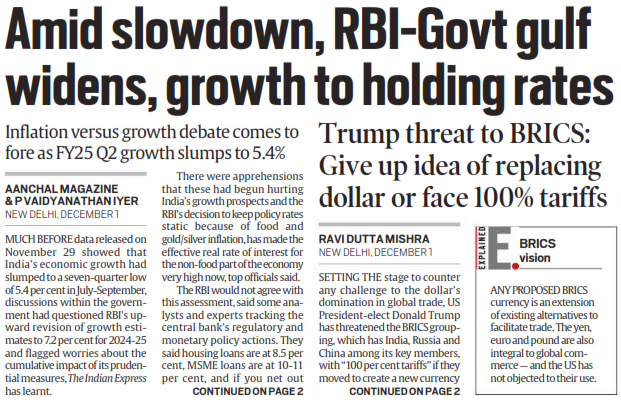
Amid slowdown, RBI-Govt gulf widens, growth to holding rates
- India’s economic growth had slumped to a seven-quarter low of 5.4 per cent in July-September, discussions within the government had questioned RBI’s upward revision of growth estimates to 7.2 per cent for 2024-25 and flagged worries about the cumulative impact of its prudential measures.
Highlights:
- Recent data indicating a slump in India’s economic growth to 5.4% in Q2 of 2024-25 has reignited the debate over the Reserve Bank of India’s (RBI) monetary policy stance. Tensions between the government and the central bank highlight conflicting views on inflation targeting, growth prospects, and monetary policy actions.
RBI’s Growth Forecast: A Point of Contention
- The RBI raised its GDP growth estimate for 2024-25 to 7.2%, contrary to indicators such as a delayed monsoon and high inflation.
- Government officials viewed this revision as overly optimistic, given signals of slowing growth and weaker capex from both central and state governments.
Prudential Measures: Impact on Growth
- The RBI introduced several macro-prudential measures to address credit exuberance, including:
- Higher risk weights on unsecured personal loans.
- Proposals for stricter provisioning norms for project loans.
- Regulations on digital lending.
- These measures, while individually sound, were seen to cumulatively constrain credit growth.
- Credit-deposit ratio concerns: The RBI’s focus on reducing this ratio led to a decline in credit growth from 16% in January 2024 to 11% in recent months, dampening economic momentum.
- Analysts argued that slowing credit could hinder deposit growth, creating a cyclical impact on liquidity.
Inflation Targeting vs. Growth Stimulation:
- The RBI has prioritized keeping inflation within its mandated 4% +/- 2% range, despite significant food price shocks.
Food Inflation Trends:
- October 2024: Retail inflation surged to 6.21%, with food inflation reaching 10.87%.
- Food and beverages constitute 45.86% of the Consumer Price Index (CPI).
- While the RBI attributes high inflation to supply shocks, the government views food-driven inflation as outside the central bank’s control and argues that monetary tightening for such transient factors is counterproductive.
Core Inflation and Policy Decisions:
- Core inflation (excluding food and fuel) rose from 3.2% to 4.2% in three months, with gold and silver contributing significantly.
- Critics within the government argue that core inflation, excluding volatile components like precious metals, remains tame, warranting a more accommodative monetary policy.
The Inflation-Growth Debate:
- RBI’s Stance: Price stability is paramount, with Governor Shaktikanta Das emphasizing the need to avoid a resurgence of inflation.
- Government’s Perspective: Current monetary policy is seen as overly restrictive, with limited focus on supporting economic growth during a cyclical slowdown.
Potential Policy Shifts and Outlook:
- The upcoming Monetary Policy Committee (MPC) meeting (December 4-6) will be closely watched for signals of policy changes.
- As Governor Das’s term nears its end on December 10, debates on balancing inflation control and growth stimulation are likely to intensify.
Prelims Takeaways
- NBFCs
- Retail inflation
- Monetary Policy Committee (MPC)
- Consumer Price Index (CPI)