
Analyzing Maharashtra’s water crisis
- After the deficient monsoon last year, the Maharashtra government declared many parts of the State to be drought-hit.
- This situation is in sharp contrast with the State’s coastal areas, where rainfall has often been in excess, leading to severe flooding.
Rain-shadow effect
- Marathwada lies in the rain-shadow region of the Western Ghats.
- When moist winds from the Arabian Sea encounter these mountains, they rise and cool, causing heavy rainfall (2,000-4,000 mm) on the western side.
- But by the time these winds cross the Ghats and descend into Western Maharashtra and Marathwada, they lose most of their moisture, leaving Marathwada much drier (600-800 mm).
- A 2016 study by IIT Gandhinagar researchers said climate change is worsening the situation in central Maharashtra.
- The region has experienced an increasing trend in drought severity and frequency of late.
- As a result, Marathwada and North Karnataka have emerged as the second driest regions in India after Rajasthan.
Sugarcane Crop in Marathwada region
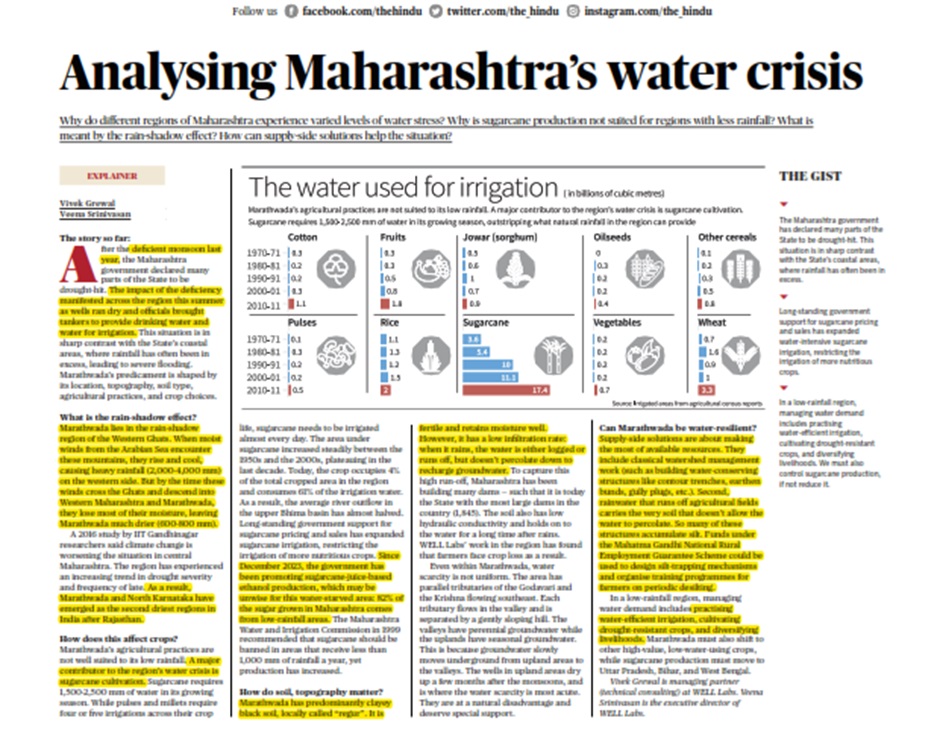
- Marathwada’s agricultural practices are not well suited to its low rainfall.
- A major contributor to the region’s water crisis is sugarcane cultivation.
- Sugarcane requires 1,500-2,500 mm of water in its growing season it also needs to be irrigated almost every day.
- The area under sugarcane increased steadily between the 1950s and the 2000s, plateauing in the last decade.
- Today, the crop occupies 4% of the total cropped area in the region and consumes 61% of the irrigation water.
- As a result, the average river outflow in the upper Bhima basin has almost halved.
- Long-standing government support for sugarcane pricing and sales has expanded sugarcane irrigation, restricting the irrigation of more nutritious crops.
- Since December 2023, the government has been promoting sugarcane-juice-based ethanol production, which may be unwise for this water-starved area
- 82% of the sugar grown in Maharashtra comes from low-rainfall areas.
- Marathwada has predominantly clayey black soil, locally called “regur”.
- It is fertile and retains moisture well. However, it has a low infiltration rate: when it rains, the water is either logged or runs off, but doesn’t percolate down to recharge groundwater.
- Even within Marathwada, water scarcity is not uniform.
- This is because groundwater slowly moves underground from upland areas to the valleys.
- The wells in upland areas dry up a few months after the monsoons, and is where the water scarcity is most acute.
Suggestive Measures
- Classical watershed management work (such as building water-conserving structures like contour trenches, earthen bunds, gully plugs, etc.).
- Funds under the Mahatma Gandhi National Rural Employment Guarantee Scheme could be used to design silt-trapping mechanisms and organise training programmes for farmers on periodic desilting.
- In a low-rainfall region, managing water demand includes practising water-efficient irrigation, cultivating drought-resistant crops, and diversifying livelihoods.
- Marathwada must also shift to other high-value, low-water-using crops, while sugarcane production must move to Uttar Pradesh, Bihar, and West Bengal.