
Bangladesh political crisis: Indian exporters stare at disruption in goods flow, brace for payment delays
- The political turmoil in Bangladesh has raised concerns among Indian exporters.
Highlights:
- Ongoing political turmoil can potentially lead to disruption in the flow of goods at the India-Bangladesh border and payment delays to Indian traders.
- Developments in Bangladesh came at a time when the country is grappling with an economic crisis.
- High inflation has eroded Dhaka’s US dollar reserves, limiting the country’s ability to import critical goods such as agricultural items, iron and steel, electricity, and plastics from India.
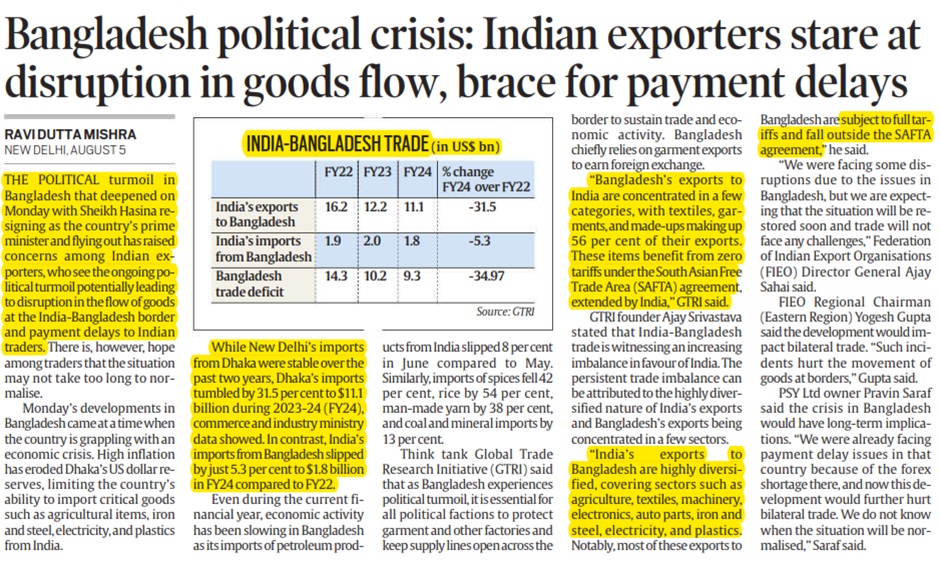
- While New Delhi’s imports from Dhaka were stable over the past two years, Dhaka’s imports tumbled by 31.5 per cent to $11.1 billion during 2023-24 (FY24), commerce and industry ministry data showed.
- In contrast, India’s imports from Bangladesh slipped by just 5.3 per cent to $1.8 billion in FY24 compared to FY22.
- Even during the current financial year, economic activity has been slowing in Bangladesh as its imports of petroleum products from India slipped 8 per cent in June compared to May.
- Think tank Global Trade Research Initiative (GTRI) said that as Bangladesh experiences political turmoil, it is essential for all political factions to protect garment and other factories and keep supply lines open across the border to sustain trade and economic activity.
- Bangladesh chiefly relies on garment exports to earn foreign exchange.
- Bangladesh’s exports to India are concentrated in a few categories, with textiles, garments, and made-ups making up 56 per cent of their exports.
- These items benefit from zero tariffs under the South Asian Free Trade Area (SAFTA) agreement, extended by India
- GTRI founder Ajay Srivastava stated that India-Bangladesh trade is witnessing an increasing imbalance in favour of India.
- The persistent trade imbalance can be attributed to the highly diversified nature of India’s exports and Bangladesh’s exports being concentrated in a few sectors.
- India’s exports to Bangladesh are highly diversified, covering sectors such as agriculture, textiles, machinery, electronics, auto parts, iron and steel, electricity, and plastics.
- Notably, most of these exports to Bangladesh are subject to full tariffs and fall outside the SAFTA agreement.
- While the crisis in Bangladesh poses several risks to India’s trade, proactive measures and regional cooperation can help mitigate these impacts and ensure continued economic stability and growth.
- The need of the hour is to have a balanced approach, keeping geopolitical and economic considerations in mind
Prelims Takeaway
- India-Bangladesh trade