
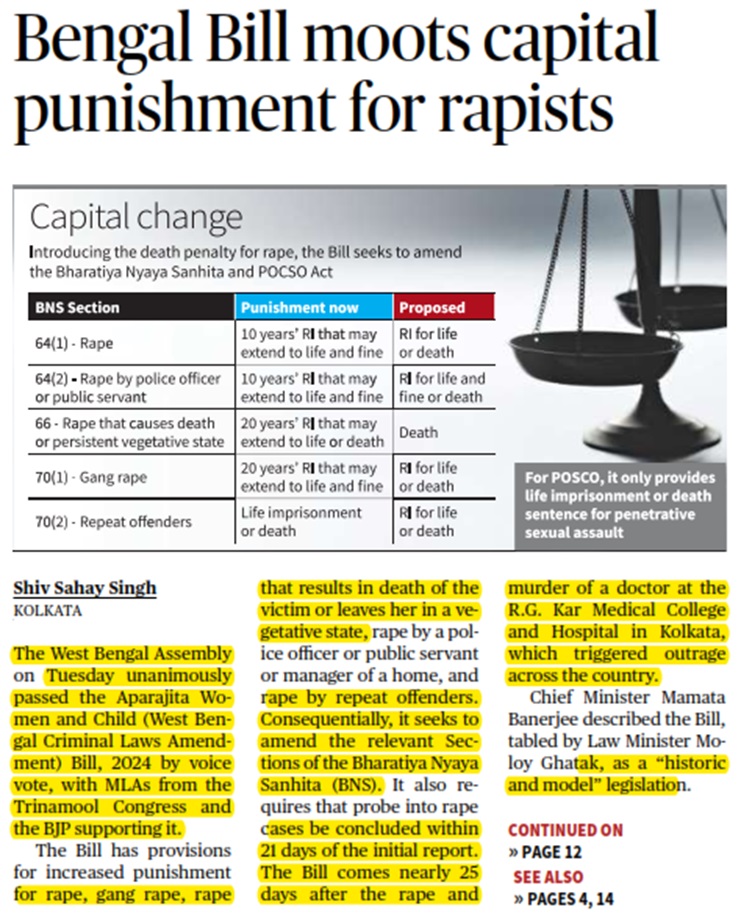
Bengal Bill moots capital punishment for rapists
- The Bill introduces three critical elements - increased punishment, speedy investigation, and rapid dispensation of justice, specifically targeting cases of sexual assault
Highlights:
- In a significant legislative move, the West Bengal Legislative Assembly passed the Aparajita Women and Child (West Bengal Criminal Laws Amendment) Bill, 2024, with unanimous support on September 3, 2024.
- This landmark bill was introduced in the wake of a tragic incident—the rape and murder of a doctor at R.G. Kar Medical College and Hospital—that shocked the state and the nation.
- The bill, backed by both the ruling Trinamool Congress (TMC) and the Bharatiya Janata Party (BJP), aims to bolster the legal framework surrounding crimes against women and children.
The Context and
- The brutal crime that catalyzed this legislative action occurred just 25 days before the bill was passed.
- The incident not only sparked outrage across West Bengal but also raised national concerns about the safety of women in public spaces.
- Chief Minister Mamata Banerjee described the bill as a "historic and model Bill," reflecting the government's resolve to deliver justice swiftly and effectively.
- The urgency of the situation was underscored by the fact that the case had been handed over to the Central Bureau of Investigation (CBI) under the directions of the Calcutta High Court, with the Chief Minister expressing her trust in the CBI to bring the culprits to justice.
Key Provisions of the Bill
- Increased Punishment: The bill increases the quantum of punishment for crimes of sexual assault, particularly in cases where the victim dies or is left in a vegetative state. It includes provisions for capital punishment in such extreme cases, signaling a zero-tolerance approach to heinous crimes.
- Speedy Investigation: The legislation mandates that investigations into rape cases must be completed within 21 days of the initial report. This is intended to ensure that justice is not delayed, which is crucial in preventing further trauma to the victims and their families.
- Rapid Dispensation of Justice: By aligning with the Bharatiya Nyay Samhita (BNS) and the Protection of Children from Sexual Offences (POCSO) Act, the bill seeks to streamline the judicial process, ensuring that cases are resolved swiftly and efficiently.
- The formation of a special 'Aparajita Task Force' within the State police is another significant aspect of the bill. This task force will be responsible for overseeing the timely completion of investigations.
Political Consensus and Debates
- The bill garnered unanimous support in the Assembly, with even the Opposition, led by Suvendu Adhikari, endorsing it. However, the debate also highlighted certain areas of contention.
- The Leader of the Opposition proposed amendments to the bill, including compulsory punishment for police officials who fail to register First Information Reports (FIRs) in cases of sexual assault.
- Notably, the BJP legislators used the occasion to criticize the state government's past actions, questioning why it had previously opposed provisions of the BNS and passed resolutions against the Union government's new criminal laws.
Public Outcry and Wider Implications
- Doctors across state-run hospitals have been protesting, demanding accountability and action.
- The Kolkata Police Commissioner, Vineet Kumar Goyal, faced calls for his resignation, with doctors submitting a resolution during their protests.
- In solidarity with the protests, prominent cultural figures have taken symbolic actions. Senior playwright Chandan Sen returned his 'Dinabandhu Mitra Puroshkar,' the highest honor in theatre, and Biplab Bandyopadhyay returned his 'Natya Academy Award,' both as a mark of protest against the state government's handling of the situation.
Prelims takeaways:
- CBI
- POCSO Act
- Natya Academy Award