
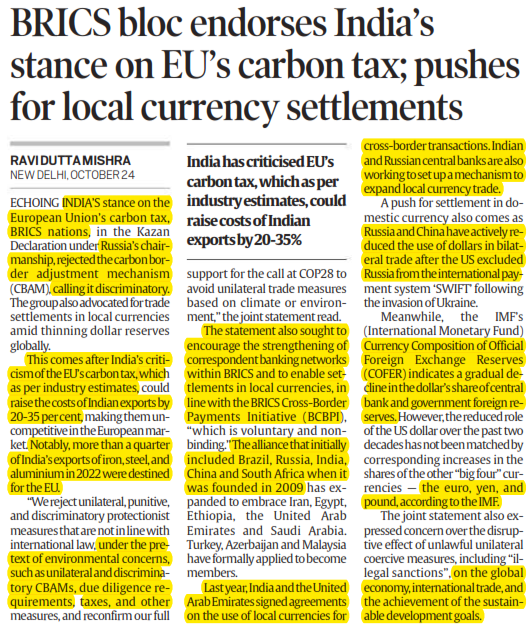
BRICS bloc endorses India's stance on EU's carbon tax; pushes for local currency settlements
- Echoing India’s stance on the European Union’s carbon tax, BRICS nations, in the Kazan Declaration under Russia’s chairmanship, rejected the carbon border adjustment mechanism (CBAM).
Highlights:
- In the Kazan Declaration, BRICS nations, under Russia’s chairmanship, rejected the European Union’s Carbon Border Adjustment Mechanism (CBAM), calling it discriminatory. They also emphasized strengthening trade settlements in local currencies to mitigate the impact of dwindling global dollar reserves.
Opposition to the EU’s CBAM
India’s Concerns on Export Competitiveness:
- India previously criticized the EU’s carbon tax, estimating it could increase export costs by 20-35%, impacting competitiveness in the European market, especially in sectors like iron, steel, and aluminum.
Joint Rejection of Unilateral Trade Measures:
- The BRICS statement condemns CBAM as a “unilateral, punitive, and discriminatory” measure. The nations pledged full support at COP28 to prevent trade measures based solely on environmental or climate grounds.
Push for Local Currency Settlements
Strengthening Correspondent Banking Networks:
- The BRICS nations plan to strengthen local currency trade networks through the BRICS Cross-Border Payments Initiative (BCBPI), aimed at reducing reliance on the US dollar. This initiative aligns with past moves by India, Russia, and the UAE to establish local currency trade mechanisms.
Context of Global Dollar Reduction:
- Amid declining dollar reserves, Russia and China have moved away from the dollar in bilateral trade since Russia’s exclusion from SWIFT, a trend echoed in the International Monetary Fund’s reports of a shrinking dollar share in foreign reserves.
Expansion of BRICS and Stance on Sanctions
BRICS Expansion:
- Initially comprising Brazil, Russia, India, China, and South Africa, BRICS recently expanded to include Iran, Egypt, Ethiopia, UAE, and Saudi Arabia, with Turkey, Azerbaijan, and Malaysia applying for membership.
Critique of Unilateral Sanctions:
- The joint statement highlighted the negative impact of “unlawful unilateral coercive measures,” such as sanctions, on the global economy and sustainable development, expressing concern over disruptions in international trade.
Prelims Takeaways:
- BRICS Cross-Border Payments Initiative (BCBPI)
- carbon border adjustment mechanism (CBAM)
- Currency Composition of Official Foreign Exchange Reserves (COFER)