
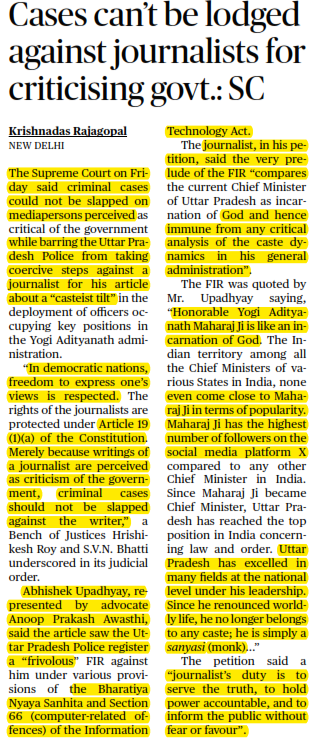
Cases can’t be lodged against journalists for criticising govt.: SC
- The Supreme Court on Friday (October 4, 2024) said criminal cases could not be slapped on media persons perceived as critical of the government while barring the Uttar Pradesh Police
Highlights:
- The Supreme Court of India, on Friday, asserted that criminal charges should not be imposed on journalists for content perceived as critical of the government.
- This ruling came while restraining the Uttar Pradesh (UP) Police from taking any coercive action against a journalist accused of writing an article highlighting caste-based biases in the Yogi Adityanath administration's officer appointments.
Judicial Ruling on Freedom of Expression:
- A Bench of Justices Hrishikesh Roy and S.V.N. Bhatti emphasized the significance of freedom of speech in democratic nations.
- The court referenced Article 19(1)(a) of the Constitution, which guarantees the freedom of speech and expression.
- The judgment underscored that merely because a journalist’s work is perceived as criticism, it cannot be a valid reason for slapping criminal charges.
The Case of Journalist Abhishek Upadhyay:
- Abhishek Upadhyay, represented by advocate Anoop Prakash Awasthi, became the subject of a First Information Report (FIR) following his article critiquing the caste composition in UP’s administration.
- The FIR was filed under various sections of the Bharatiya Nyaya Sanhita and Section 66 of the Information Technology Act.
- The article had led the UP Police to allege a “casteist tilt” in Upadhyay’s reporting, which led to what was described as a “frivolous” FIR.
FIR Details and Controversial Remarks:
- The FIR included controversial statements that praised UP Chief Minister Yogi Adityanath, portraying him as beyond criticism.
- The FIR stated, "Honorable Yogi Adityanath Maharaj Ji is like an incarnation of God" and praised his governance, emphasizing that since he became CM, UP has excelled in law and order and various national-level sectors.
- The FIR suggested that because Yogi Adityanath had renounced worldly life and caste, he was beyond any caste-based critique.
Journalist’s Petition: Upholding Truth and Accountability:
- Upadhyay’s petition reiterated the journalist's role in democracy:
- It is the duty of journalists to serve the truth, hold power accountable, and inform the public without fear or bias.
- The petition stressed the importance of freedom of speech as the "most precious right" in a democratic society.
Threats and Intimidation Faced by the Journalist:
- The petition also highlighted that Upadhyay had received threats, including:
- Legal action warnings from the official X handle of the UP Police.
- Threats of arrest and even encounter killings following the publication of the article.
Court's Next Steps:
- The Supreme Court issued notice to the State of Uttar Pradesh and scheduled the next hearing after four weeks, allowing time for further investigation and deliberation on the matter.
Prelims Takeaways:
- Article 19(1)(a) of the Constitution