
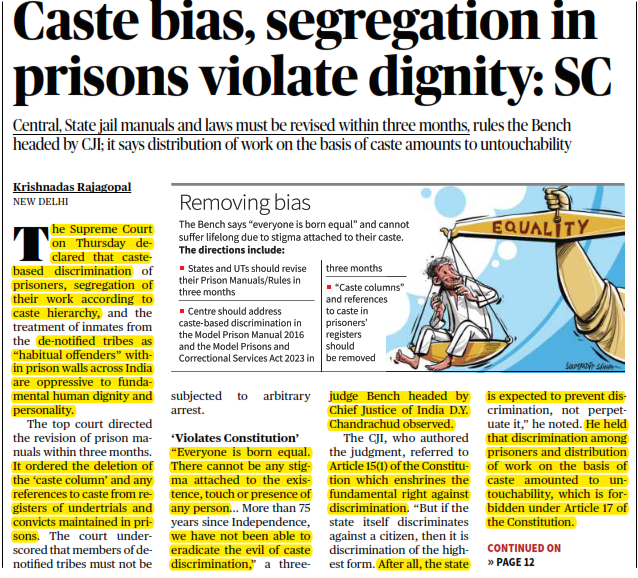
Caste bias, segregation in prisons violate dignity: SC
- The Supreme Court declared that caste-based discrimination of prisoners, segregation of their work according to caste hierarchy, and the treatment of inmates from the de-notified tribes as “habitual offenders.
Highlights:
- The Supreme Court of India has declared that caste-based discrimination and segregation of prisoners, as well as the mistreatment of de-notified tribes, violate fundamental human dignity and personality. The judgment mandates reforms in prison manuals and the removal of caste-based references.
Directive for Prison Reform:
- The court has directed the revision of prison manuals within three months. This includes the deletion of the caste column and any references to caste in prison registers for undertrials and convicts.
- The court emphasized that members of de-notified tribes must not face arbitrary arrests based on discriminatory practices.
Constitutional Violations
Article 15(1) and Discrimination:
- Chief Justice Chandrachud highlighted that Article 15(1) of the Constitution, which ensures the right against discrimination, is directly violated when the state engages in discriminatory practices.
- The judgment strongly criticized the state for perpetuating caste-based discrimination, noting that the state should protect against, rather than promote, such practices.
Article 17 and Untouchability:
- The judgment declared that the caste-based distribution of labor and segregation among prisoners amounts to untouchability, which is forbidden under Article 17 of the Constitution. This practice further infringes upon Article 23, which prohibits forced labor.
Treatment of Denotified Tribes and Habitual Offenders:
- The court condemned the colonial practice of treating members of de-notified and wandering tribes as "born criminals" and habitual offenders. It declared any such references in prison manuals unconstitutional.
Labor Segregation and Coercion in Prisons
Forced Labor Based on Caste:
- The court condemned the practice of forcing marginalized caste inmates to perform menial tasks such as cleaning latrines or sweeping, purely based on their caste, as a form of coercion. It argued that segregation based on caste in prisons would only perpetuate caste-based hatred and animosity.
No Scavenger Class:
- The court rejected the classification of any social group as a "scavenger class" and criticized prison manuals for assigning tasks like manual scavenging based on caste.
- It held that the Prohibition of Employment as Manual Scavengers and their Rehabilitation Act, 2013, applies within prisons as well.
Modern Prison Laws and Caste-Based Privileges
Flaws in Modern Prison Laws:
- The judgment also criticized the Union government's Modern Prison Manual of 2016 and the Model Prisons and Correctional Services Act of 2023 for perpetuating caste-based discrimination.
- These laws, which assign duties such as cooking and kitchen work based on caste or religion, were found to continue the legacy of caste-based privileges in prisons.
Mandate for Reform:
- The Supreme Court has directed the Union government to address these discriminatory practices and amend the 2016 Manual and the 2023 Act within three months.
Case Background:
- The ruling was based on a petition filed by journalist Sukanya Shantha, who highlighted discriminatory practices in over 10 states, including Uttar Pradesh, West Bengal, and Tamil Nadu. One glaring example was the segregation of Thevars, Nadars, and Pallars in different sections of the Palayamkottai Central Jail in Tamil Nadu.
Prelims Takeaways:
- Model Prisons and Correctional Services Act of 2023