
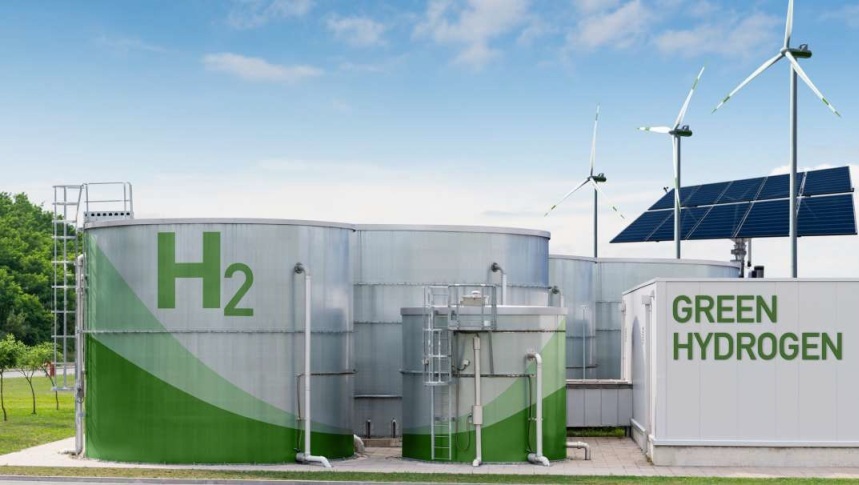
Centre issues Scheme Guidelines for funding of testing facilities, infrastructure, and institutional support under the National Green Hydrogen Mission
- The Ministry of New and Renewable Energy has recently issued guidelines aimed at funding testing facilities, infrastructure, and institutional support under the National Green Hydrogen Mission. These guidelines focus on developing standards and a regulatory framework essential for the mission's success.
- The new guidelines will help identify gaps in the current testing facilities for green hydrogen components, technologies, and processes.
- It will facilitate the creation of new testing facilities and upgrade existing ones to ensure safe and secure operations.
- The scheme, with a total budget of ₹200 crore until the financial year 2025-26, is part of the broader ₹19,744 crore allocation under the mission.
- The National Institute of Solar Energy will act as the implementation agency for this scheme.
What is the National Green Hydrogen Mission?
- The National Green Hydrogen Mission is designed to incentivize the commercial production of green hydrogen, to position India as a net exporter of this fuel.
- The mission aims to foster demand creation, production, utilization, and export of green hydrogen.
Sub Schemes:
- Strategic Interventions for Green Hydrogen Transition Programme (SIGHT): This initiative will fund the domestic manufacturing of electrolysers and the production of green hydrogen.
- Green Hydrogen Hubs: States and regions with the potential for large-scale production or utilization of hydrogen will be identified and developed as Green Hydrogen Hubs.
Objective:
- To establish a green hydrogen production capacity of at least 5 million metric tonnes (MMT) per annum by 2030.
- To add approximately 125 GW of renewable energy capacity by 2030.
- The mission is expected to attract investments over ₹8 lakh crore and create around six lakh jobs.
- It will help reduce fossil fuel imports by over ₹1 lakh crore and lower annual greenhouse gas emissions by nearly 50 MT.
Significance:
- The mission will contribute to the decarbonization of industrial, mobility, and energy sectors.
- It aims to reduce dependence on imported fossil fuels and feedstock.
- It will foster the development of indigenous manufacturing capabilities and create employment opportunities.
- The mission encourages the development of new technologies, such as efficient fuel cells.
Potential:
- India has favorable geographic conditions and abundant sunlight and wind resources, making it ideal for green hydrogen production.
- Green hydrogen technologies are particularly useful in sectors where direct electrification is challenging, such as heavy-duty, long-range transport, certain industrial sectors, and long-term power storage.
- The early stage of the industry presents an opportunity to create regional hubs that export high-value green products and provide engineering, procurement, and construction services.
Challenges:
- Nascent Stage Globally: Green hydrogen development is still in its early stages worldwide. While India can emerge as a major producer, it currently lacks the necessary infrastructure to support all intermediary steps.
- Economic Sustainability: A significant challenge is the economic viability of green hydrogen production. For hydrogen to be commercially viable, it must be cost-competitive with conventional fuels and technologies.
What is Green Hydrogen?
- Hydrogen is a crucial industrial fuel used in producing ammonia, steel, refining processes, and electricity.
- Currently, most hydrogen is derived from coal and is referred to as 'black' or 'brown' hydrogen.
- Pure hydrogen is rare; it usually exists in compounds like H2O (water). Electrolysis, using renewable electricity, can split water into oxygen and hydrogen, producing green hydrogen.
- Different colors indicate the electricity source used to produce hydrogen, such as brown (coal), grey, blue, and green (renewable sources).
Current Production:
- Green hydrogen accounts for less than 1% of global hydrogen production due to high costs.
- Production costs vary: black hydrogen (USD 0.9-1.5/kg), grey hydrogen (USD 1.7-2.3/kg), blue hydrogen (USD 1.3-3.6/kg), and green hydrogen (USD 3.5-5.5/kg).
Need for Producing Green Hydrogen:
- Hydrogen has a high energy content per unit weight, making it a valuable energy source, even for rocket fuel.
- Green hydrogen is one of the cleanest energy sources, with near-zero emissions. It is suitable for fuel cells in cars and energy-intensive industries like fertilizer and steel manufacturing.
- Global efforts to build green hydrogen capacity aim to enhance energy security and reduce carbon emissions.
Way Forward:
- Incentives are needed to encourage industrial hydrogen users to adopt green hydrogen.
- Developing supply chains, including pipelines, tankers, storage, and distribution networks, is crucial.
- A comprehensive skill development program is essential to train workers for the green hydrogen economy.
- Leveraging low-cost renewable plants and cost-curtailment experience from solar and wind auctions can reduce green hydrogen costs.
- India's young demographic and thriving economy present significant market potential for hydrogen-based technologies.
Prelims Takeaway
- National Green Hydrogen Mission