
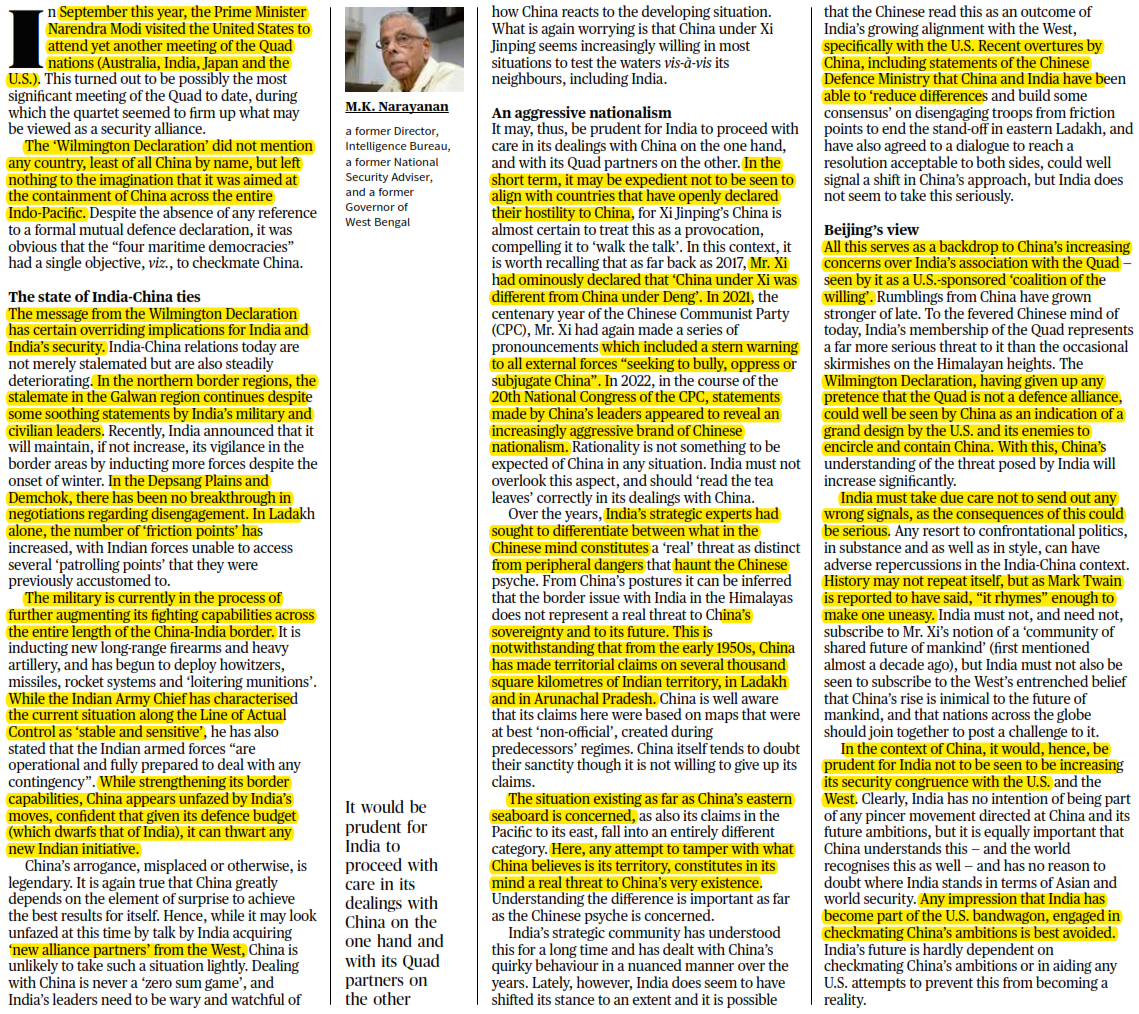
China, India and New Delhi’s Quad dilemma
- In September 2024, Indian Prime Minister Narendra Modi visited the United States for a significant meeting of the Quad nations (Australia, India, Japan, and the U.S.), where the group appeared to consolidate its stance as a security alliance. Although the Wilmington Declaration made no direct mention of China, the objective of countering Chinese influence in the Indo-Pacific was clear.
- This evolving dynamic in India's foreign policy, particularly regarding its ties with the Quad and China, presents challenges that require a delicate balancing act.
The Quad and China: A Growing Tension:
- While the Wilmington Declaration avoided specific references, the Quad's alignment undeniably signals a coordinated effort to checkmate China's influence in the Indo-Pacific region. China, in turn, views the Quad as an effort to stir up conflict and has been vocal in accusing it of inciting confrontation.
- The alignment of the "four maritime democracies" is perceived by China as a move against its broader regional ambitions, particularly in maritime security and dominance.
Deteriorating India-China Relations:
- India-China relations, meanwhile, have been in a state of steady deterioration. The situation along the Line of Actual Control (LAC) remains tense, especially in regions like Galwan, Depsang Plains, and Demchok, where no breakthrough has been reached on disengagement.
- India's military buildup—through the deployment of long-range firearms, heavy artillery, and advanced missile systems—has been aimed at countering China's growing assertiveness. Yet, China appears confident in its military superiority, buoyed by its significantly larger defense budget.
- However, China's overconfidence, historically marked by the element of surprise, may not be entirely reassuring for India, which must remain cautious of potential escalations.
India's Strategic Approach to China:
- While it is crucial for India to remain vigilant, it would be prudent to avoid any overt alignment with countries overtly hostile to China. Xi Jinping's China is highly sensitive to external pressures, as evidenced by his declarations of a new, more assertive Chinese identity since 2017.
- Over the years, China’s aggressive nationalism has been a cause for concern for neighboring countries, including India. Yet, Indian strategic experts understand that while China's territorial claims in the Himalayas are important, they do not pose an existential threat to Beijing. The more significant danger for China lies in threats to its eastern seaboard and Pacific claims.
- India's nuanced approach to China has been to differentiate between perceived peripheral threats and those that pose a real threat to China's sovereignty. However, India's recent alignment with the West, particularly through its increasing ties with the U.S., could be interpreted by China as a strategic shift.
- Statements from Chinese officials about reducing differences and building consensus on troop disengagement in Ladakh reflect China’s wariness, but India has not fully engaged with these overtures.
The Quad and China's Response:
- China’s concern over India’s participation in the Quad has intensified, as Beijing sees it as a U.S.-led coalition designed to contain its rise. The Wilmington Declaration, despite its diplomatic language, has heightened these concerns, reinforcing China's belief that the Quad is evolving into a defense alliance aimed at encircling it.
- For India, while balancing ties with the Quad members is important, it must also be mindful of the implications of being perceived as part of a grand design to contain China.
- India must avoid giving China the impression that it is part of a U.S.-led effort to checkmate Chinese ambitions. The consequences of such a perception could be significant, potentially leading to increased border tensions and greater diplomatic friction. History offers ample lessons that confrontational politics in this region can have long-term consequences.
A Balanced Approach: India’s Role in the Indo-Pacific:
- India's role in the Indo-Pacific and its relations with China must be based on a carefully calculated strategy. Aligning too closely with Western powers could provoke unnecessary antagonism from China, while remaining disengaged could weaken India’s security position in the Indo-Pacific. India's future should not be defined by its role in containing China but by its capacity to independently navigate regional and global dynamics.
conclusion
- India must proceed with caution in its dealings with both China and the Quad. It is in India's best interest to avoid being seen as a key player in a U.S.-led coalition against China. Instead, India should focus on maintaining a balanced, independent foreign policy that advances its own security interests while avoiding the risks of provoking China into further escalation.