
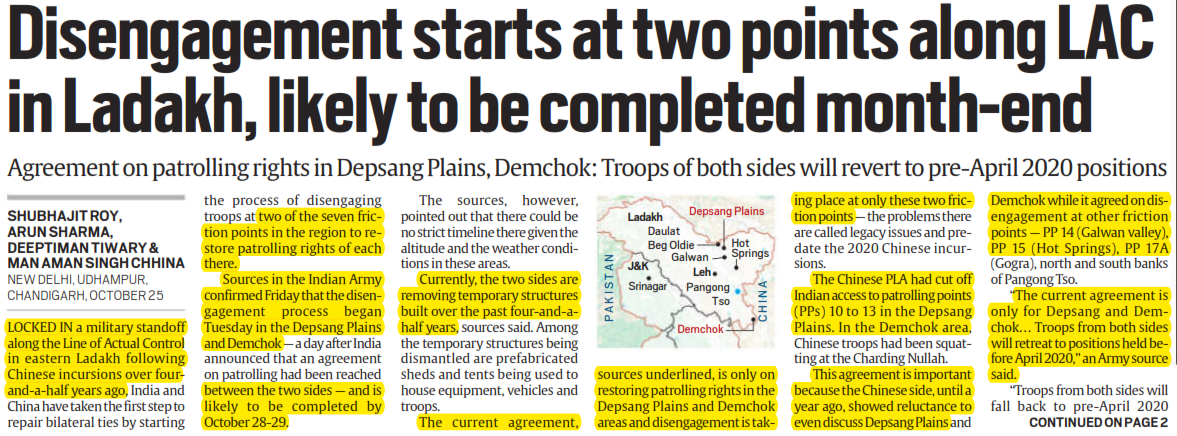
Disengagement starts at two points along LAC in Ladakh, likely to be completed month-end
- Locked in a military standoff along the Line of Actual Control in eastern Ladakh following Chinese incursions over four-and-a-half years ago, India and China have taken the first step to repair bilateral ties by starting the process of disengaging troops at two of the seven friction points in the region to restore patrolling rights of each there.
Highlights:
- After a prolonged standoff along the Line of Actual Control (LAC) in eastern Ladakh, India and China have initiated troop disengagement at two critical areas: the Depsang Plains and Demchok. Indian Army sources confirmed that this process began on Tuesday and is anticipated to be completed by October 28-29, although timelines are flexible due to challenging weather and altitude.
Removal of Temporary Structures and Restoration of Patrolling:
- The disengagement involves dismantling temporary structures, such as prefabricated sheds and tents, erected by both sides over the last four-and-a-half years. This step will enable both Indian and Chinese troops to resume patrolling in these areas, reverting to pre-April 2020 conditions and reducing the risk of future face-offs.
Agreement Covers Two of Seven Friction Points:
- The agreement currently focuses solely on restoring patrolling rights in the Depsang Plains and Demchok, areas known as "legacy issues" that existed prior to the 2020 standoff. Previously, China had blocked Indian access to several patrolling points in the Depsang Plains, and Chinese troops were stationed at Charding Nullah in Demchok.
Confidence-Building Measures and Communication:
- Both sides are implementing confidence-building measures, including regular commander-level meetings and communication about patrol launches to prevent misunderstandings. After the disengagement process, each side will verify the other’s positions to ensure compliance with the agreement.
Diplomatic and Military-Level Negotiations:
- The agreement framework was achieved through diplomatic discussions, followed by military-level negotiations and Corps Commander-level talks. Northern Army Commander Lt General M.V. Suchindra Kumar highlighted that this resolution emerged after recent diplomatic efforts.
High-Level Meetings and Strategic Talks:
- The agreement paved the way for a bilateral meeting between Prime Minister Narendra Modi and Chinese President Xi Jinping on the sidelines of the BRICS Summit in Kazan, Russia. The leaders emphasized prioritizing border peace, with External Affairs Minister S. Jaishankar noting that the agreement would help restore tranquility along the border, as seen before 2020.
Path Forward for Border Management:
- Indian Army Chief General Upendra Dwivedi outlined that restoring trust by adhering to the disengagement terms would enable the next phases of de-escalation and stable LAC management. Both nations have committed to a process aimed at achieving lasting peace along the India-China border.
Prelims Takeaways:
- Depsang Plains and Demchok