
Electronic components subsidy policy: center, Industry disagree over job creation
- Incentivising electronic components manufacturing is the next key frontier for India, after it successfully managed to localise assembly of finished electronics products such as smartphones.
Highlights:
- India's electronic components manufacturing sector is at a crossroads, as a standoff between the government and the electronics industry highlights the challenges of aligning policy objectives with industry realities.
- The Ministry of Electronics and IT (MeitY) is currently drafting an incentive policy aimed at boosting domestic manufacturing, but disagreements over job creation estimates and mechanization levels are causing delays.
Current Tensions and Challenges
- Discrepancies in Job Creation Estimates:
- The core issue at hand is the disparity between the government's job creation targets and the industry's mechanization capabilities.
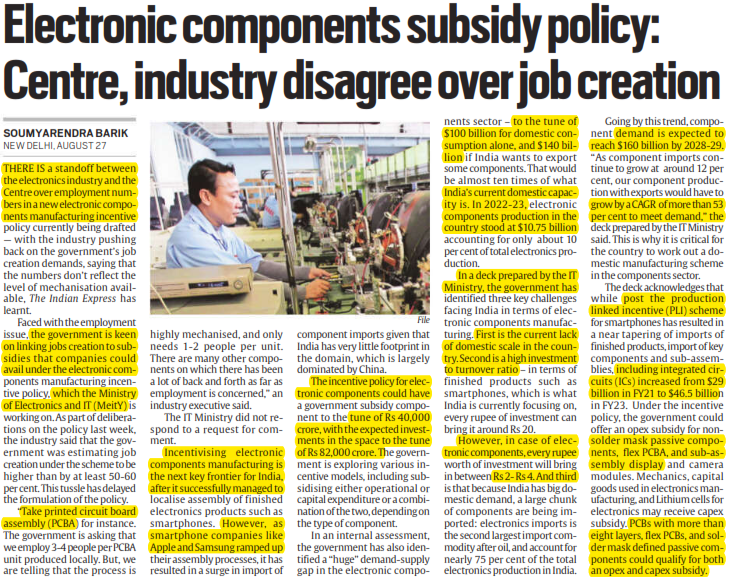
- The government’s expectation of 3-4 employees per printed circuit board assembly (PCBA) unit contrasts sharply with the industry's assertion that only 1-2 employees are needed due to high mechanization.
- This fundamental disagreement underscores the difficulty of formulating policies that accurately reflect industry practices and technological advancements.
- Impact on Policy Formulation:
- This disagreement has led to a significant delay in finalizing the electronic components manufacturing incentive policy.
- The industry’s resistance to the government's job creation demands highlights a broader issue: the challenge of crafting policies that balance job creation with the realities of modern, mechanized manufacturing processes.
- Strategic Importance of the Incentive Policy:
- The incentive policy is crucial for India’s long-term strategy to reduce dependency on imported electronic components, predominantly from China.
- With a potential subsidy of Rs 40,000 crore and investments projected at Rs 82,000 crore, the policy aims to address a massive demand-supply gap in the sector.
- However, the current standoff risks undermining these ambitious goals by delaying the implementation of necessary support mechanisms.
Strategic Considerations and Future Directions
- Addressing the Demand-Supply Gap:
- The Indian government’s internal assessments reveal a substantial demand-supply gap in electronic components, with a projected need of $100 billion for domestic consumption alone.
- The government must navigate the standoff effectively to ensure that the policy addresses both the demand-supply gap and the industry's operational realities.
- Balancing Incentives and Realities:
- The proposed policy includes various models for incentives, including operational and capital expenditure subsidies.
- To ensure the policy’s effectiveness, it is critical that these incentives are aligned with the industry's mechanization levels and actual job creation potential. This alignment will help in optimizing the policy’s impact and achieving the intended growth in domestic manufacturing.
- Strengthening Domestic Manufacturing:
- The increase in component imports, from $29 billion in FY21 to $46.5 billion in FY23, highlights the need for a robust domestic manufacturing scheme.
- By addressing the current discrepancies and aligning the policy with industry practices, India can foster a more competitive and self-reliant electronics sector.
- This will also help reduce the high investment-to-turnover ratio and promote sustainable growth in the sector.
Prelims Takeaways:
- Ministry of Electronics and IT (MeitY)
- PCBA