
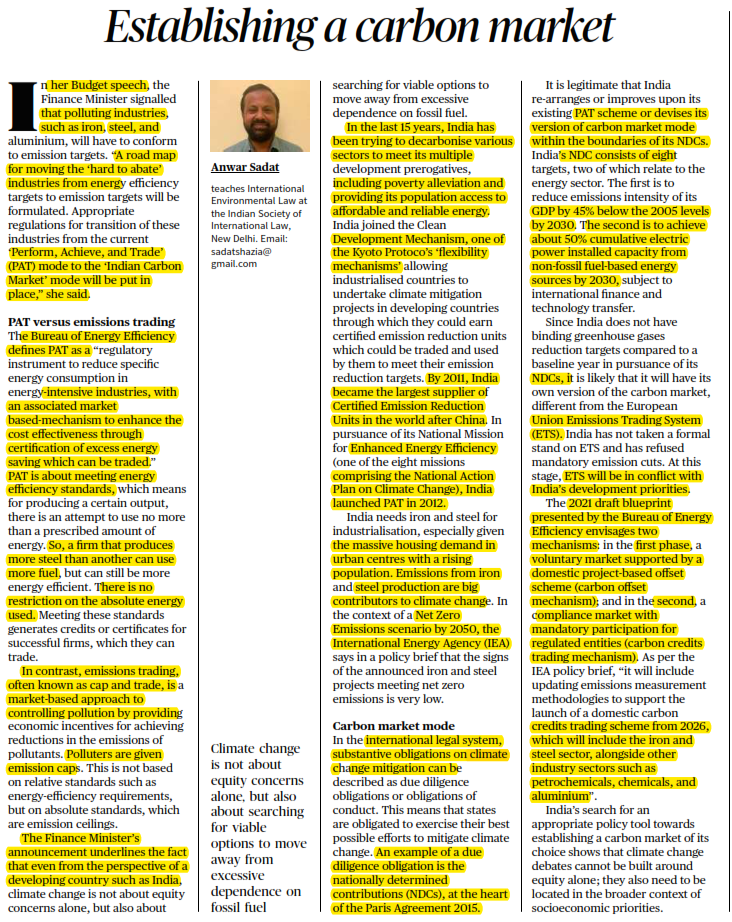
Establishing a carbon market
- In the context of India's evolving climate policy, the recent Budget announcement by the Finance Minister marks a significant transition from the existing Perform, Achieve, and Trade (PAT) scheme to a new Indian Carbon Market model.
- This strategic shift is poised to impact key industrial sectors and aligns with India's broader climate commitments.
- Key Points
- Transition from PAT to Emissions Trading:
- PAT Scheme: The PAT framework, introduced in 2012, focuses on improving energy efficiency in energy-intensive industries by setting specific energy consumption targets. Successful companies earn tradable certificates for exceeding their targets.
- However, this system only addresses relative energy efficiency and does not cap absolute emissions.
- Emissions Trading System (ETS): The new model aims to cap total emissions from industries. Companies must adhere to emission caps and can trade emission allowances, creating economic incentives for reducing overall greenhouse gas output.
- This system represents a shift towards absolute emission control.
- Alignment with Nationally Determined Contributions (NDCs):
- Emission Reduction Targets: India’s NDCs include a commitment to reduce emission intensity by 45% from 2005 levels by 2030 and to achieve 50% cumulative installed capacity from non-fossil fuel sources by 2030.
- The transition to an ETS aligns with these targets by imposing stricter emission controls.
- Sectoral Focus: The shift will affect major sectors such as iron, steel, and aluminum, which are significant contributors to emissions. Addressing emissions from these "hard to abate" industries is crucial for meeting India's climate goals.
- Challenges and Opportunities:
- Challenges: Implementing an ETS in India involves challenges, including the need to balance economic growth with environmental sustainability.
- Unlike the EU, India has not committed to binding reduction targets, which could complicate the enforcement of stringent emission caps.
- Opportunities: The introduction of a carbon market could drive innovation, attract green investments, and enhance India's global competitiveness in a market increasingly focused on sustainability.
- It offers a model for other developing countries to address climate change while pursuing economic development.
- Policy and Developmental Considerations:
- Economic Growth vs. Environmental Goals: India’s development priorities, including poverty alleviation and industrialization, must be considered alongside climate goals.
- The phased approach to carbon trading—starting with voluntary participation and moving towards mandatory compliance—reflects a balanced strategy.
- Global Context: India’s approach to establishing its carbon market will influence global climate strategies and offer insights into how developing nations can contribute to international climate goals without compromising on growth.