
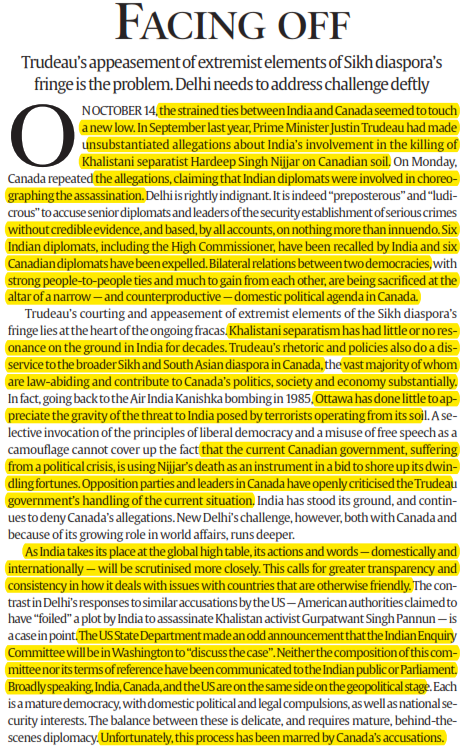
FACING OFF
- On October 14, 2024, the diplomatic rift between India and Canada reached a new low, as Canada reiterated serious allegations against India concerning the assassination of Khalistani separatist Hardeep Singh Nijjar.
- Prime Minister Justin Trudeau’s unsubstantiated claims regarding India’s involvement have led to a significant escalation in tensions, culminating in the expulsion of diplomats from both countries.
- This crisis raises urgent questions about the motivations behind such allegations and the implications for bilateral relations between two democracies with strong historical ties.
Background: The Allegations and Their Implications:
- In September 2023, Trudeau alleged that India had a role in Nijjar's killing on Canadian soil, a claim that India has categorically denied. The recent accusations of Indian diplomats orchestrating this assassination are described by New Delhi as “preposterous” and “ludicrous.” This situation has forced India to recall six diplomats, including the High Commissioner, in a clear signal of its indignation.
- The allegations appear to stem from a broader political agenda in Canada, where Trudeau's government is accused of appeasing extremist elements within the Sikh diaspora. Such actions not only undermine the credibility of the Canadian government but also harm the interests of the vast majority of law-abiding Sikh Canadians who contribute positively to society.
The Broader Context: Khalistani Separatism:
- Khalistani separatism, which has not resonated in India for decades, has found a more vocal platform in Canada. The ongoing tensions reflect the failure of the Canadian government to address the complexities surrounding this issue and its historical connection to terrorism on Canadian soil.
- Trudeau’s selective embrace of liberal democratic principles and free speech has been criticized as a cover for political maneuvering amid a domestic crisis. His government appears to be leveraging Nijjar’s death to shore up its political standing, a tactic that could have dangerous ramifications for Canada-India relations.
The Diplomatic Balancing Act:
- As India seeks to enhance its role on the global stage, it must navigate its international relations with greater transparency and consistency. The scrutiny of India's actions will intensify, particularly when addressing accusations from nations like Canada and the United States.
- Recent accusations from the US regarding a foiled assassination plot against Khalistani activist Gurpatwant Singh Pannun highlight the necessity for a nuanced approach. India's response to these varied accusations must align with its broader diplomatic objectives.
- The contrast in India’s handling of these allegations points to a need for a robust communication strategy. The Indian Enquiry Committee's planned discussions with American authorities have raised questions about transparency and public accountability. The lack of clarity surrounding the committee's composition and terms has not gone unnoticed by the Indian public and Parliament, underscoring the need for open dialogue in such matters.
The Path Forward: Diplomacy Over Rhetoric:
- Despite the tensions, it is crucial to remember that India, Canada, and the US share mutual interests on the geopolitical front. As mature democracies, these nations face the dual challenge of addressing domestic political pressures while safeguarding national security interests.
- Both sides must prioritize behind-the-scenes diplomacy to resolve misunderstandings and avert further deterioration of relations. Canada’s allegations, while politically motivated, threaten to undermine decades of cooperation between the two countries, which share significant people-to-people ties and economic interests.
Conclusion: A Call for Restraint and Understanding:
- The recent strain in India-Canada relations serves as a stark reminder of the fragility of diplomatic ties in the face of political agendas. As both nations navigate this turbulent period, it is imperative to prioritize dialogue, transparency, and mutual respect.
- The resolution of this crisis will depend on both countries' commitment to uphold the principles of diplomacy and cooperation, ensuring that political posturing does not compromise the enduring ties between India and Canada.
- Only through constructive engagement can both nations work toward a future that benefits their citizens and reinforces their standing on the global stage.