
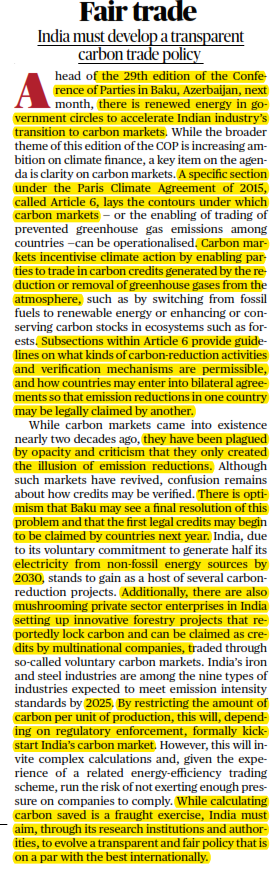
Fair trade
- As the 29th Conference of Parties (COP29) approaches in Baku, Azerbaijan, there is a renewed commitment within the Indian government to expedite the country’s transition to carbon markets. With climate finance as the overarching theme, a significant focus will be on clarifying the operational frameworks for carbon markets as outlined in Article 6 of the Paris Climate Agreement.
The Role of Carbon Markets:
- Carbon markets are designed to facilitate the trading of carbon credits, allowing countries to capitalize on their greenhouse gas emissions reductions. This mechanism incentivizes climate action by enabling countries to trade credits generated from activities that either reduce emissions or enhance carbon sequestration, such as transitioning to renewable energy or conserving forests.
- Article 6 lays out the principles for these transactions, specifying permissible activities, verification processes, and bilateral agreements that allow emission reductions from one country to be credited to another.
Historical Context and Current Challenges:
- Although carbon markets were established nearly two decades ago, they have faced significant criticism for lacking transparency and effectiveness. Critics argue that they often create the illusion of emissions reductions without producing real, measurable impacts.
- Recent discussions have revived interest in these markets, with the hope that the COP29 will yield clearer guidelines and resolutions on credit verification processes. There is optimism that this clarity could lead to the first legal carbon credits being claimed as early as next year.
India's Strategic Position:
- India is well-positioned to benefit from the carbon market landscape, particularly due to its commitment to sourcing half of its electricity from non-fossil fuel sources by 2030. This commitment opens the door for a range of carbon-reduction projects across the country.
- Additionally, a burgeoning private sector focused on innovative forestry projects aims to lock carbon and generate credits that multinational companies can trade in voluntary carbon markets.
- In the industrial sector, India’s iron and steel industries are among nine sectors expected to meet emission intensity standards by 2025. This regulatory framework will set limits on carbon emissions per unit of production, marking a significant step toward formally establishing India’s carbon market.
- However, it also raises concerns about the complexity of calculations involved in determining carbon savings and the potential for regulatory enforcement issues.
The Path Forward
- To successfully navigate the transition to carbon markets, India must develop a transparent and equitable policy framework that aligns with international best practices.
- This necessitates collaboration between research institutions, policymakers, and industry stakeholders to create robust verification processes and enforcement mechanisms. Lessons learned from past initiatives, such as energy-efficiency trading schemes, must inform the design of these frameworks to ensure compliance and efficacy.
Conclusion
- The upcoming COP29 in Baku presents a critical opportunity for India to solidify its position in the emerging carbon market landscape. By enhancing clarity around carbon credits and committing to a transparent policy framework, India can leverage its commitments to non-fossil energy sources and carbon reduction initiatives.
- The focus on carbon markets not only aligns with global climate goals but also supports India’s ambition to foster a sustainable and competitive economy in the face of climate change.