
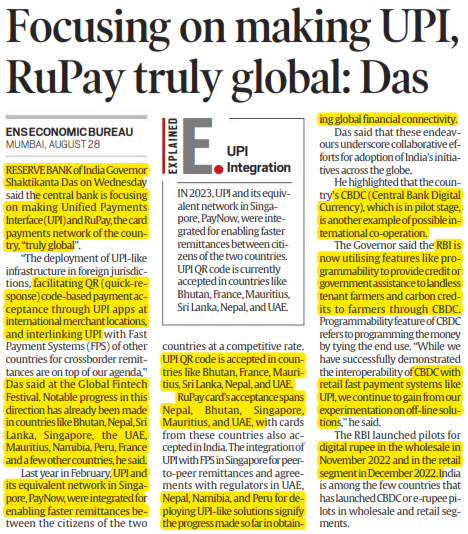
Focusing on making UPI, RuPay truly global: Das
- UPI, the country’s real-time retail payment system, and its equivalent network in Singapore, PayNow, were integrated for enabling faster remittances between the citizens of the two countries at a highly competitive rate.
Highlights:
- The Reserve Bank of India (RBI) is spearheading efforts to make India’s payment systems, particularly the Unified Payments Interface (UPI) and RuPay, globally recognized and utilized.
- In a recent address at the Global Fintech Festival, RBI Governor Shaktikanta Das highlighted the central bank’s focus on expanding the reach of UPI and RuPay to international markets, underscoring the role of these initiatives in enhancing global financial connectivity and promoting financial inclusion.
UPI and RuPay: Expanding Global Footprint
- Global Integration of UPI: UPI, India's real-time retail payment system, has gained significant traction domestically and is now being positioned as a global standard for digital payments.
- The RBI is actively working to deploy UPI-like infrastructure in foreign jurisdictions, facilitating the acceptance of UPI-based payments through QR codes at international merchant locations.
- This effort aims to streamline cross-border remittances by interlinking UPI with Fast Payment Systems (FPS) of other countries.
- Current Reach: UPI has already been integrated with Singapore's PayNow, enabling faster and cost-effective remittances between the two countries. Additionally, UPI QR codes are accepted in countries such as Bhutan, France, Mauritius, Sri Lanka, Nepal, and the UAE.
- RuPay Card Network: RuPay, India's indigenous card payment network, is also being extended globally. The acceptance of RuPay cards in countries like Nepal, Bhutan, Singapore, Mauritius, and the UAE signifies a growing international footprint.
- This expansion facilitates seamless transactions for Indian travelers and businesses abroad, while also enabling cards from these countries to be used in India.
Strategic Significance for India
- Financial Inclusion and Connectivity: The global expansion of UPI and RuPay is a strategic move towards enhancing financial inclusion, not just within India but also globally.
- By enabling secure, real-time payments across borders, these initiatives are set to bridge financial gaps, particularly for the Indian diaspora and businesses engaged in international trade.
- Strengthening India's Financial Ecosystem: The international adoption of UPI and RuPay underscores India's growing influence in the global financial ecosystem. These efforts are aligned with the broader goal of positioning India as a leader in fintech innovation.
- The integration of UPI with foreign FPS systems and the global acceptance of RuPay cards are likely to bolster India's economic ties with other nations and facilitate smoother financial transactions.
- Role of Central Bank Digital Currency (CBDC): Governor Das also highlighted the potential of India’s Central Bank Digital Currency (CBDC), currently in its pilot stage, to foster international cooperation.
- The RBI has demonstrated the interoperability of CBDC with retail payment systems like UPI, and is exploring its use in providing targeted financial assistance, such as credits to landless farmers.
Prelims Takeaways:
- Global Fintech Festival
- Fast Payment Systems (FPS)