
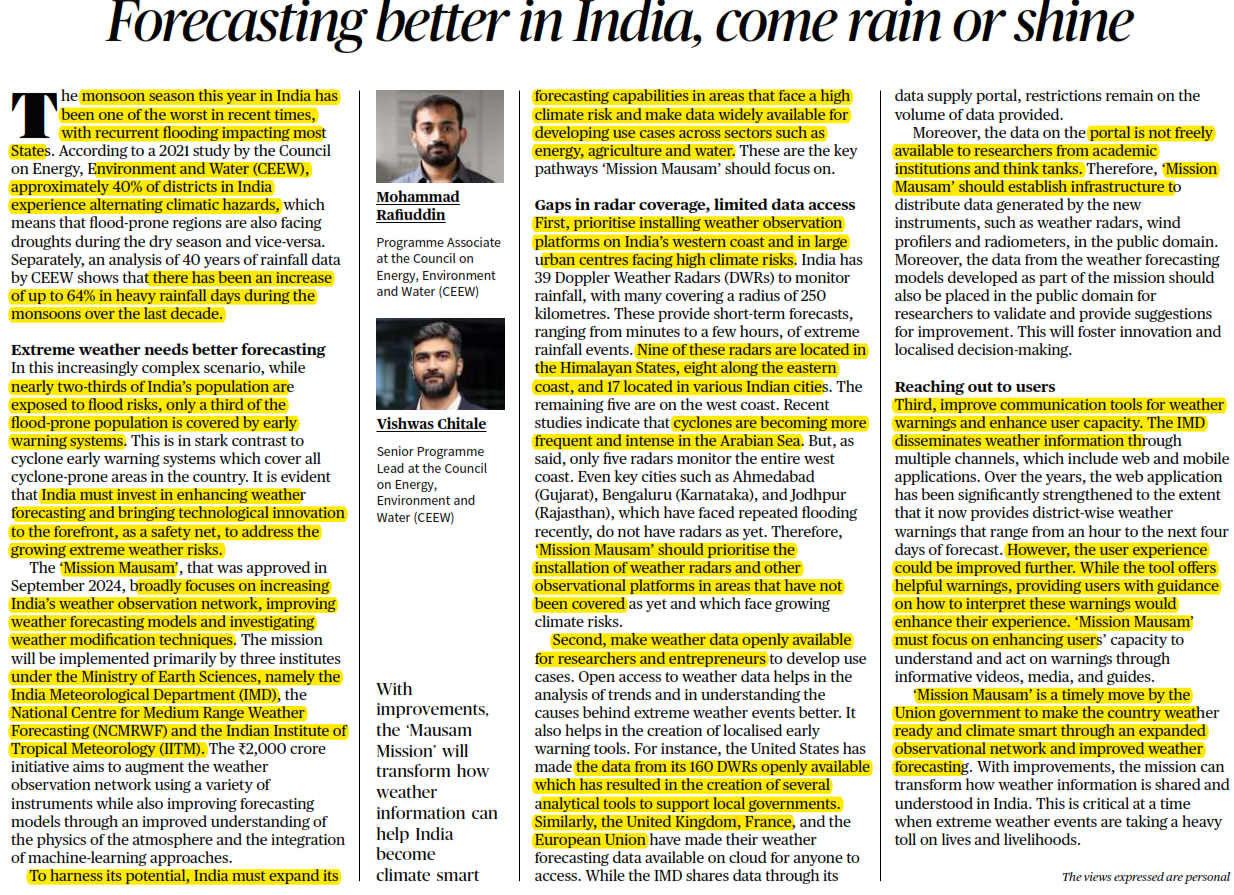
Forecasting better in India, come rain or shine
- The 2024 monsoon season in India has been one of the worst in recent times, with severe flooding affecting numerous states. This reflects a disturbing pattern of increasing climate volatility, as highlighted by the Council on Energy, Environment and Water (CEEW).
- According to a 2021 CEEW study, around 40% of Indian districts now experience alternating climatic hazards, where flood-prone regions also face droughts during the dry season, leading to devastating impacts on livelihoods and infrastructure.
- CEEW’s analysis of 40 years of rainfall data reveals a 64% rise in heavy rainfall days during the monsoons over the last decade, signaling that the climate crisis is escalating.
Challenges in Weather Forecasting and the Need for Enhanced Systems:
- Despite the growing risks, nearly two-thirds of India’s population are still exposed to flood hazards, while only a third are covered by early warning systems. In contrast, cyclone-prone areas are entirely covered by these systems, showcasing a gap in flood preparedness.
- Enhancing weather forecasting and integrating technological innovations is critical to mitigate these risks and provide a robust safety net against extreme weather events.
- Recognizing this need, the Indian government launched Mission Mausam in September 2024, an initiative designed to enhance weather observation, improve forecasting models, and explore weather modification techniques. The ₹2,000 crore mission aims to expand the weather observation network and integrate machine learning to improve the accuracy of forecasts, ensuring India is better prepared for increasingly erratic weather patterns.
Key Priorities for ‘Mission Mausam’
Expanding the Weather Observation Network:
- India currently operates 39 Doppler Weather Radars (DWRs), each covering a 250-kilometer radius to provide short-term forecasts of rainfall and extreme events. However, gaps remain in radar coverage, particularly along the western coast and major urban centers like Ahmedabad, Bengaluru, and Jodhpur, which have recently suffered repeated flooding. To address these vulnerabilities:
- Mission Mausam must prioritize installing new DWRs in high-risk areas, especially the western coast, where cyclones in the Arabian Sea are becoming more frequent.
- These systems need to be deployed not only in cities but also in rural areas, which are often disproportionately impacted by floods and lack access to early warnings.
Open Data Access for Innovation:
- Access to weather data is crucial for improving weather forecasting and fostering innovation in sectors like agriculture, energy, and water management. While the IMD shares some data through its portal, restrictions on data volume hinder research and development efforts.
- In contrast, countries like the United States, United Kingdom, and the European Union provide open access to weather data, enabling the development of tools for local governments and businesses.
- Mission Mausam should establish an infrastructure to freely distribute data from new instruments, such as weather radars, wind profilers, and radiometers.
- By making forecasting models accessible, researchers can validate data and offer improvements, fostering a culture of innovation and more localized decision-making.
Improving Communication and User Experience:
- India’s IMD provides weather information through mobile and web platforms, offering district-level forecasts that range from one hour to four days. While this is a valuable service, more can be done to improve the user experience and capacity to act on these warnings. The goal should be to:
- Enhance communication tools with interactive features and guidance videos that help users interpret warnings.
- Develop region-specific guidelines that help citizens, especially those in vulnerable areas, understand how to respond to warnings.
Conclusion: Transforming India’s Weather Readiness:
- Mission Mausam is a much-needed step towards making India more resilient to extreme weather. By expanding the weather observation network, making data accessible for innovation, and improving communication, India can become climate-smart and weather-ready.
- This mission is particularly critical at a time when floods, droughts, and other weather-related hazards are increasing in frequency, threatening lives, infrastructure, and the economy. With timely improvements, Mission Mausam can reshape how weather information is shared, understood, and acted upon in India.