
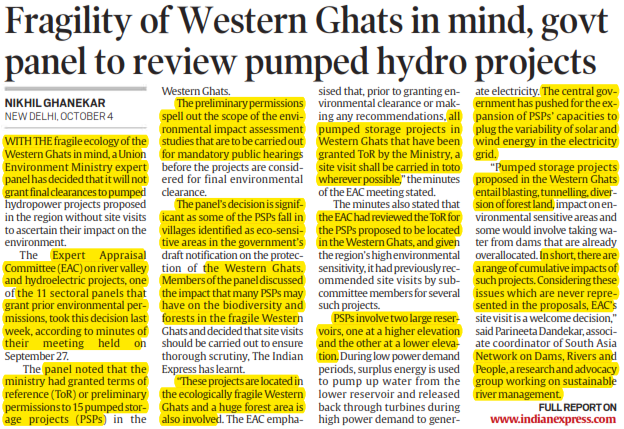
Fragility of Western Ghats in mind, govt panel to review pumped hydro projects
- With the fragile ecology of the Western Ghats in mind, a Union Environment Ministry expert panel has decided that it will not grant final clearances to pumped hydropower projects proposed in the region
Highlights:
- The Western Ghats, a UNESCO World Heritage site, is one of the world's most biodiverse and ecologically fragile regions. Rich in flora and fauna, it plays a critical role in regulating South India's climate and water systems.
- However, it also faces growing threats from developmental projects, particularly Pumped Storage Projects (PSPs), which could have detrimental impacts on its environment.
EAC's Decision: No Final Clearances Without Site Visits:
- In light of the ecological sensitivity of the Western Ghats, the Expert Appraisal Committee (EAC) of the Union Environment Ministry has taken a crucial step.
- The committee, responsible for evaluating river valley and hydroelectric projects, decided that it would not grant final environmental clearances to proposed PSPs in the region without conducting on-site assessments.
- This decision was made during the EAC’s meeting on September 27, 2024, and reflects growing concerns about the potential environmental risks of these projects.
Significance of the Decision:
- High Environmental Sensitivity: Several of the proposed PSPs are located in villages identified as eco-sensitive areas in the government's draft notification on Western Ghats protection. The region is home to dense forests, sacred groves, and several species of wildlife, some of which are endangered.
- Potential Impact: PSPs involve blasting, tunnelling, and diversion of forest land, activities that could disrupt the delicate balance of the ecosystem. Additionally, some projects may rely on water from already overallocated dams, further stressing local water resources.
The Pumped Storage Project Model:
- PSPs function by utilizing two reservoirs, one at a higher elevation and the other at a lower elevation. During periods of low power demand, surplus energy is used to pump water from the lower reservoir to the upper one. During periods of high demand, water is released back down to generate electricity.
Cumulative Environmental Concerns:
- Parineeta Dandekar, associate coordinator of the South Asia Network on Dams, Rivers, and People, highlighted the cumulative impacts of these projects. These include:
- Displacement of local biodiversity due to forest diversion.
- Risk of obstructing small rivulets that are key water sources for perennial rivers.
- Potential disturbance to sacred groves and fish sanctuaries, which hold cultural and ecological significance for local communities.
Case Study: Warasgaon Warangi PSP:
- A notable decision by the EAC involved the Warasgaon Warangi PSP in Maharashtra, proposed by Adani Green Energy Limited. The project, originally granted preliminary clearance in February 2023, sought an expansion in capacity from 1,200 MW to 1,500 MW.
- However, the panel raised concerns about the increase in the total forest land required for the project, which expanded from 24.5 hectares to 88.98 hectares.
- The panel concluded that the changes would have a significant environmental impact, especially given that the area includes eco-sensitive villages like Teckpole and Warangi.
Prelims Takeaways:
- Expert Appraisal Committee (EAC)
- UNESCO World Heritage sites