
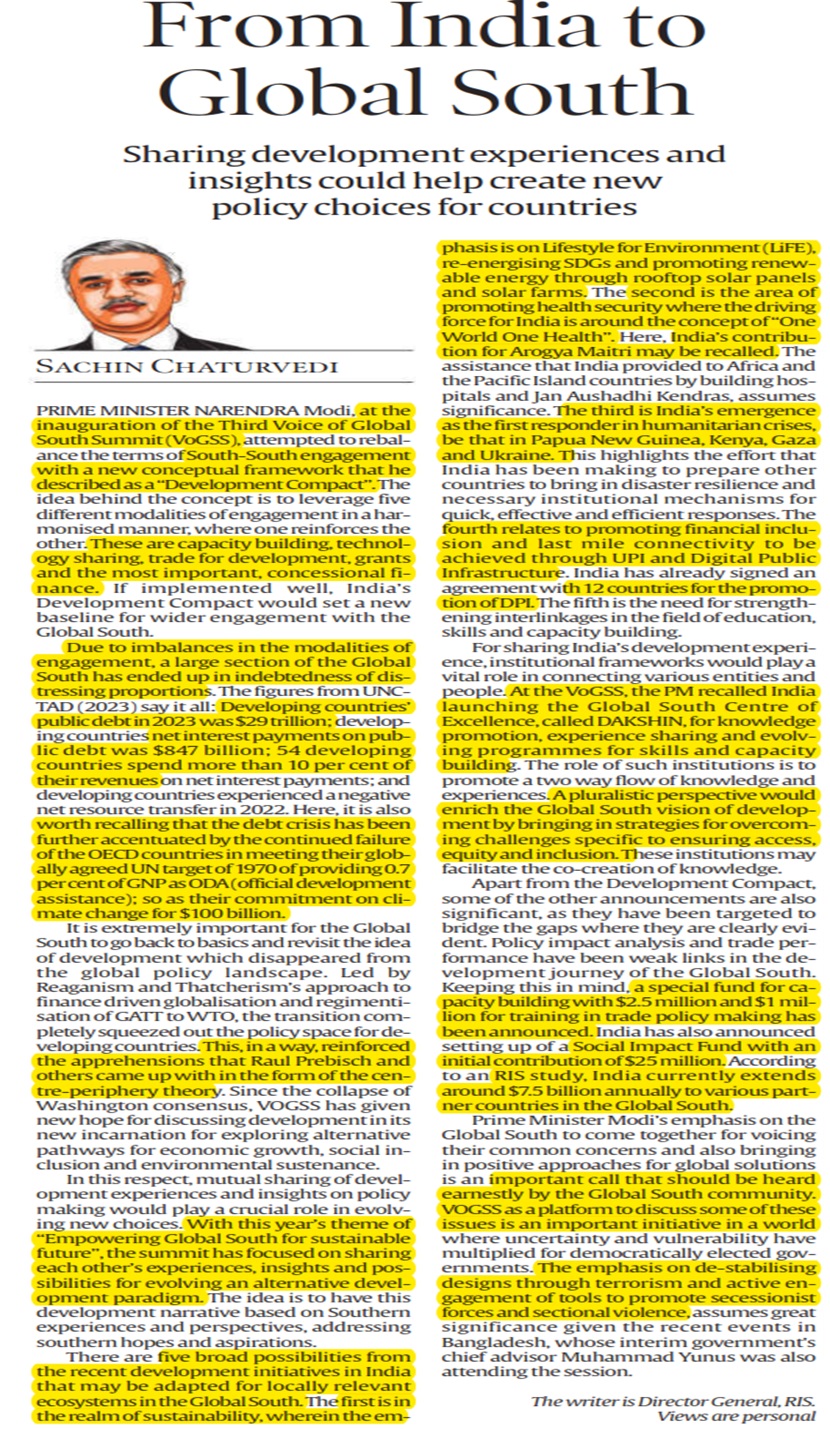
From India to Global South
- At the inauguration of the Third Voice of Global South Summit (VoGSS), Prime Minister Narendra Modi introduced the Development Compact, a new framework aimed at redefining the terms of South-South cooperation.
- The Development Compact encompasses five interlinked modalities of engagement—capacity building, technology sharing, trade for development, grants, and concessional finance—designed to create a harmonised approach that reinforces itself and benefits the Global South.
Addressing Global South’s Debt Crisis:
- One of the key motivations behind the Development Compact is to counter the growing indebtedness of countries in the Global South. According to UNCTAD (2023), developing countries' public debt has reached a staggering $29 trillion, with $847 billion in annual net interest payments.
- This mounting debt, coupled with the failure of OECD countries to meet their official development assistance (ODA) commitments of 0.7% of GNP, has exacerbated the financial stress in these nations.
- Modi's call for a Development Compact is an attempt to alleviate this burden through concessional finance and more equitable forms of cooperation.
- By prioritising development as a core objective, the initiative also challenges the legacy of the Washington Consensus and finance-driven globalisation, which limited the policy space for developing countries. In this context, the VoGSS offers a platform to rekindle the focus on inclusive development, rooted in southern perspectives and experiences.
Learning from India’s Development Initiatives:
- India's recent development experiences offer five significant areas of potential collaboration for the Global South:
- Sustainability: India’s emphasis on Lifestyle for Environment (LiFE), promoting renewable energy such as rooftop solar panels, and re-energising the Sustainable Development Goals (SDGs) can provide valuable models for other countries.
- Health Security: The concept of One World, One Health, through initiatives like Arogya Maitri, underscores India’s role in building health infrastructure in Africa and the Pacific Islands. India’s efforts in setting up hospitals and Jan Aushadhi Kendras highlight its commitment to global health security.
- Humanitarian Response: India’s proactive role as a first responder in humanitarian crises across the globe—such as in Papua New Guinea, Kenya, and Ukraine—exemplifies its leadership in building disaster resilience and rapid response mechanisms.
- Financial Inclusion: India’s expertise in Digital Public Infrastructure (DPI), particularly through the Unified Payments Interface (UPI), has set a global benchmark for financial inclusion. Agreements with 12 countries to promote DPI underline the potential for cooperation in this area.
- Education and Skills Development: Strengthening interlinkages in education, skills, and capacity building remains crucial for sustainable development in the Global South. India's launch of the Global South Centre of Excellence (DAKSHIN) seeks to promote knowledge exchange and skills development, serving as a platform for co-creating solutions tailored to local needs.
Bridging the Development Gaps: Key Announcements:
- In addition to the Development Compact, Modi’s announcements at the summit aimed at addressing key gaps in development for the Global South. These included:
- A special fund for capacity building with an initial contribution of $2.5 million, along with $1 million dedicated to training in trade policy-making.
- The establishment of a Social Impact Fund with an initial capital of $25 million, to drive social development projects.
- India currently extends approximately $7.5 billion annually to partner countries in the Global South, reflecting its commitment to fostering mutual growth.
Global South’s Collective Voice:
- PM Modi emphasised the need for the Global South to unite and voice their shared concerns on global platforms. VoGSS, as a forum, plays an essential role in this effort, offering a space to discuss issues such as economic vulnerability, terrorism, and secessionist movements, which destabilise many nations in the region.
- The presence of leaders like Muhammad Yunus from Bangladesh underscores the urgency of addressing these challenges in a coordinated manner.
- The Development Compact and associated initiatives mark an important shift in India’s approach to South-South cooperation, promoting a vision of development that is inclusive, sustainable, and collaborative.
- The VoGSS provides a vital platform for the Global South to realign its priorities and work together toward a future that reflects their collective aspirations.