
Good rains, full reservoirs
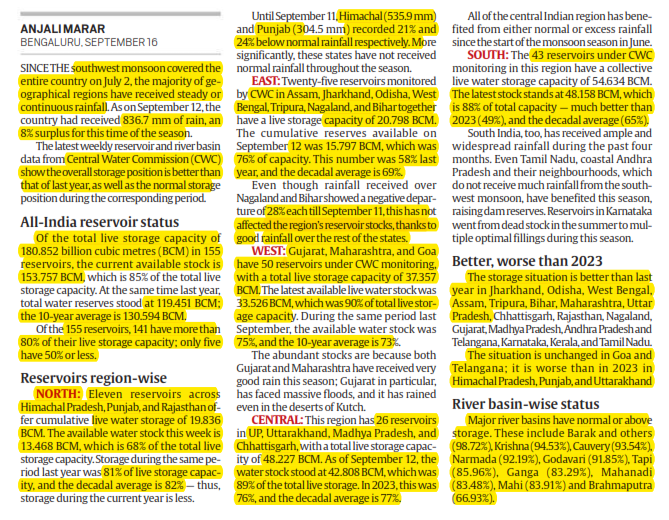
- Except in North India, reservoirs are filled close to capacity almost everywhere in the country. The overall storage position is much better than that of last year, as well as the 10-year-average storage at this time
Highlights:
- As of September 12, 2024, India has received 836.7 mm of rainfall, an 8% surplus for this time of year. The Southwest Monsoon, which covered the entire country by July 2, has resulted in significant and steady rainfall in most regions.
- The latest data from the Central Water Commission (CWC) shows that water storage levels in reservoirs across the country are higher than both last year's levels and the 10-year average.
All-India Reservoir Status:
- India’s 155 major reservoirs have a total live storage capacity of 180.852 billion cubic metres (BCM), and currently, 153.757 BCM (85%) of that capacity is filled. This is a substantial increase compared to 119.451 BCM last year and the 10-year average of 130.594 BCM.
- 141 reservoirs have more than 80% of their live storage capacity filled.
- Only five reservoirs have less than 50% capacity.
Region-Wise Reservoir Storage
- Northern Region:
- States: Himachal Pradesh, Punjab, Rajasthan
- Live Storage Capacity: 19.836 BCM
- Current Storage: 13.468 BCM (68% of total capacity)
- Comparison with Last Year: The current storage is lower than the 81% storage level of the previous year and the 82% decadal average.
- Rainfall Situation: Himachal and Punjab have received 21% and 24% below normal rainfall, affecting reservoir levels.
- Eastern Region:
- States: Assam, Jharkhand, Odisha, West Bengal, Tripura, Nagaland, Bihar
- Live Storage Capacity: 20.798 BCM
- Current Storage: 15.797 BCM (76% of total capacity)
- Comparison with Last Year: Storage has significantly improved from 58% last year, and the 69% decadal average.
- Rainfall Situation: Nagaland and Bihar have faced a 28% deficit in rainfall, but good rains in other states have kept reservoir levels steady.
- Western Region
- States: Gujarat, Maharashtra, Goa
- Live Storage Capacity: 37.357 BCM
- Current Storage: 33.526 BCM (90% of total capacity)
- Comparison with Last Year: Reservoirs are at 75% capacity compared to last year, and the decadal average is 73%.
- Rainfall Situation: Gujarat and Maharashtra have seen heavy rainfall, with Gujarat experiencing massive floods, contributing to the high reservoir levels.
- Central Region
- States: Uttar Pradesh, Uttarakhand, Madhya Pradesh, Chhattisgarh
- Live Storage Capacity: 48.227 BCM
- Current Storage: 42.808 BCM (89% of total capacity)
- Comparison with Last Year: The storage is higher than 76% last year and the 77% decadal average.
- Rainfall Situation: This region has benefited from either normal or excess rainfall throughout the monsoon season.
- Southern Region
- States: Karnataka, Kerala, Tamil Nadu, Andhra Pradesh, Telangana
- Live Storage Capacity: 54.634 BCM
- Current Storage: 48.158 BCM (88% of total capacity)
- Comparison with Last Year: Reservoirs are significantly better stocked than last year’s 49%, and the decadal average of 65%.
- Rainfall Situation: Even regions like Tamil Nadu and coastal Andhra Pradesh, which typically do not receive heavy southwest monsoon rainfall, have benefited this season.
River Basin-Wise Storage
- Major river basins across the country are also showing normal or above-normal water storage levels:
- Barak and Others: 98.72%
- Krishna: 94.53%
- Cauvery: 93.54%
- Narmada: 92.19%
- Godavari: 91.85%
- Tapi: 85.96%
- Ganga: 83.29%
- Mahanadi: 83.48%
- Mahi: 83.91%
- Brahmaputra: 66.93%
Better and Worse Than 2023
- Reservoir storage is better than last year in several states, including Jharkhand, Odisha, West Bengal, Assam, Bihar, Maharashtra, Uttar Pradesh, Chhattisgarh, Rajasthan, Gujarat, Madhya Pradesh, Andhra Pradesh, Telangana, Karnataka, Kerala, and Tamil Nadu. However, the situation has deteriorated in Himachal Pradesh, Punjab, and Uttarakhand, mainly due to below-normal rainfall in these areas.
Prelims Takeaways:
- Central Water Commission