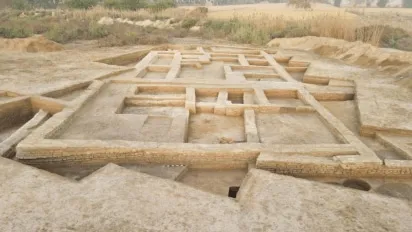
| Event | Haryana government declares Mitathal and Tighrana as protected archaeological sites. |
| Date of Notification | March 13, 2025 |
| Issued By | Kala Ramachandran, Principal Secretary of Haryana Heritage and Tourism |
| Legal Framework | Haryana Ancient and Historical Monuments and Archaeological Sites and Remains Act, 1964 |
| Purpose | Safeguard sites from encroachment and damage; implement fencing and security arrangements. |
| Mitathal Site | |
| - Discovery | First discovered in 1913; hoard of coins belonging to Samudra Gupta (Gupta dynasty). |
| - Excavation | Excavated in 1968; revealed Copper-Bronze Age culture (3rd-2nd millennia BCE). |
| - Area | 10 acres |
| - Features | Harappan-style town planning, architecture, arts, and crafts. |
| - Pottery | Sturdy red ware, well-burnt, painted in black with pipal leaf, fish scale, geometric designs. |
| - Artifacts | Beads, bangles, terracotta, objects made of stone, shell, copper, ivory, and bone. |
| Tighrana Site | |
| - Period | Post-Harappan/Chalcolithic Culture (around 2,400 BCE). |
| - Inhabitants | Chalcolithic agricultural communities called Sothians. |
| - Settlement Features | Thatched-roofed mud-brick houses, possibly fortified; 50 to 100 houses per settlement. |
| - Lifestyle | Agriculture, domestication of animals (cows, bulls, goats). |
| - Tools | Wheel-made ceramics, bichrome black-and-white designs; copper, bronze, and stone tools. |
| - Craft Industry | Beads, green carnelian bangles indicating jewelry and bead-making trade. |
| - Chronological Significance | Remains from Pre-Siswal, Pre-Harappan, and Post-Harappan periods. |