
India, ASEAN nations to look at linking payment systems
- The two sides declared that they would explore collaboration of cross-border linkages between payment systems in ASEAN and India through digital solutions.
Highlights:
- India has pledged to share its expertise in digital public infrastructure (DPI), such as Aadhaar and Unified Payments Interface (UPI), with ASEAN nations. This partnership aims to explore collaborations in sectors such as education, healthcare, agriculture, and climate change.
Key Outcomes of the 21st India-ASEAN Summit:
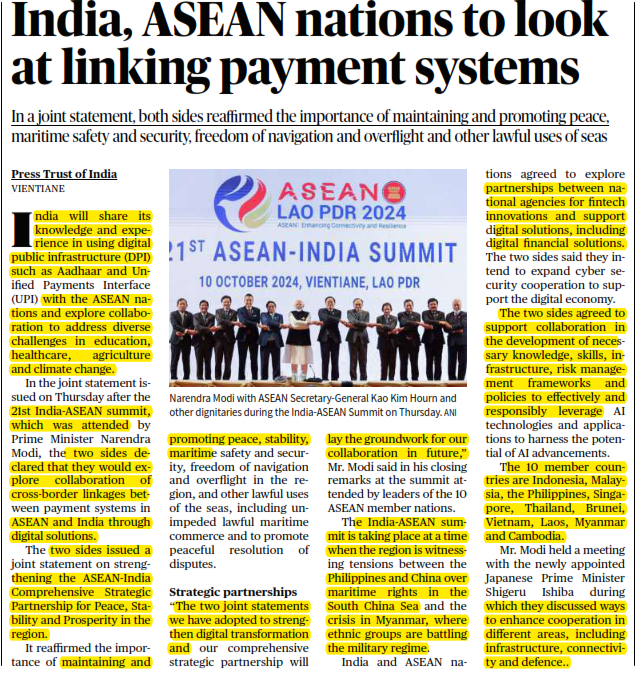
- At the 21st India-ASEAN summit, attended by Prime Minister Narendra Modi and leaders of 10 ASEAN member nations, several important areas of cooperation were outlined.
- Cross-Border Payment Systems Collaboration:
- India and ASEAN nations agreed to explore the collaboration of cross-border payment systems using digital solutions, enhancing financial integration between the two regions. This aligns with India's efforts to share its experience with DPI like UPI.
- Strengthening the Strategic Partnership:
- A joint statement was issued to reaffirm the strengthening of the ASEAN-India Comprehensive Strategic Partnership. This partnership focuses on peace, stability, and prosperity in the region.
- Emphasis on Maritime Security:
- Both sides underscored the importance of maintaining peace and stability in maritime zones, particularly emphasizing the significance of maritime safety, security, freedom of navigation, and the peaceful resolution of disputes in the South China Sea region.
Digital Transformation and AI Collaboration:
- The summit also laid the groundwork for digital transformation partnerships:
- Fintech Innovation: India and ASEAN nations plan to foster partnerships between national fintech agencies and support digital financial solutions.
- Cybersecurity: Cooperation in cybersecurity will be expanded to safeguard the growing digital economy.
- Artificial Intelligence (AI): The two sides agreed to collaborate on responsible AI technology use, emphasizing skills, infrastructure, and risk management frameworks.
Regional Context: South China Sea and Myanmar:
- The summit occurred amidst regional tensions, particularly the Philippines-China maritime disputes and the ongoing crisis in Myanmar. India's involvement with ASEAN, through collaboration on strategic and economic fronts, is seen as a step toward maintaining stability in the region.
Bilateral Meetings on the Sidelines:
- Prime Minister Modi also held bilateral discussions with other leaders, including the Prime Ministers of Japan and New Zealand.
- Meeting with Japanese Prime Minister Shigeru Ishiba:
- During his first meeting with Japan's new Prime Minister, Modi discussed enhancing cooperation in various sectors such as:
- Infrastructure
- Connectivity
- Defense
- Cultural linkages
- The talks reaffirmed India’s commitment to its Act East Policy and the deepening of the India-Japan Strategic and Global Partnership.
- Meeting with New Zealand Prime Minister Christopher Luxon:
- Modi’s meeting with New Zealand's PM focused on economic cooperation, tourism, education, and innovation. Modi welcomed New Zealand's decision to join the International Solar Alliance, highlighting the potential for cooperation in renewable energy and other sectors.
Prelims Takeaways:
- International Solar Alliance
- India-Japan Strategic and Global Partnership