
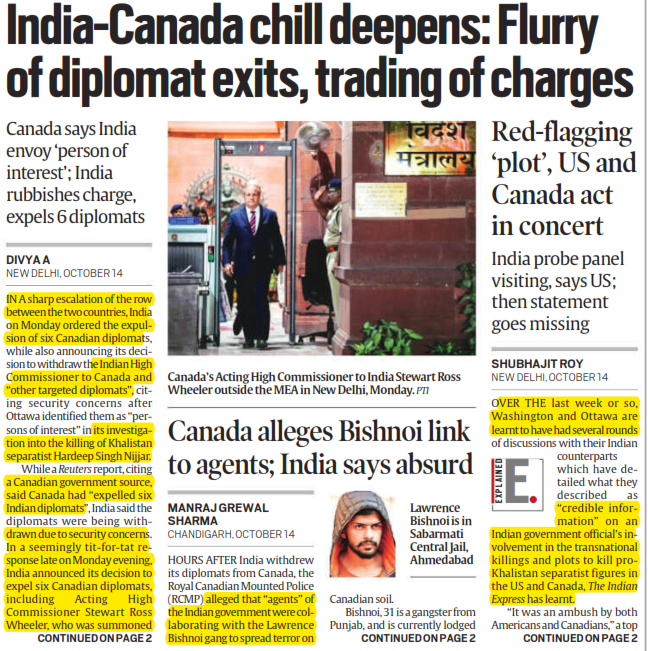
India-Canada chill deepens: Flurry of diplomat exits, trading of charges
- The day of fast-paced developments began with the Ministry of External Affairs (MEA) issuing a hard-hitting response to Canada's “preposterous imputations” on the involvement of Indian diplomats in the Nijjar case.
Highlights:
- The diplomatic fallout between India and Canada, ignited by Canadian Prime Minister Justin Trudeau's allegations in September 2023, continues to worsen. At the heart of the dispute is the Nijjar case, where Trudeau claimed India’s potential involvement in the June 2023 killing of Hardeep Singh Nijjar, a Canada-based Khalistan separatist.
- India's Ministry of External Affairs (MEA) has staunchly rejected these claims as politically motivated and rooted in Trudeau’s domestic vote-bank politics.
India’s Firm Rejection of Canada’s Allegations:
- The diplomatic strain deepened with a formal communication from Canada, implicating Indian diplomats, including High Commissioner Sanjay Kumar Verma, in the Nijjar case. India's response was swift, labeling the allegations as “preposterous imputations” aimed at serving Trudeau's political agenda.
- The MEA’s hard-hitting response emphasized that the accusations lacked credibility, attributing them to Trudeau's attempt to cater to separatist factions within his electoral base.
- The MEA further warned that India reserves the right to take further steps in response to Canada's diplomatic actions. This could entail reciprocal measures, given that India has already expelled several Canadian diplomats and withdrawn its own High Commissioner from Ottawa.
Canada’s Stance and the Diplomatic Rift:
- Despite India’s strong rejection, Canadian officials, including their High Commissioner Wheeler, have maintained that their claims are backed by “credible, irrefutable evidence.” Wheeler emphasized Canada’s readiness to cooperate with India in investigating the alleged links between Indian agents and the murder.
- India has long accused Canada of harboring extremists, specifically pointing to the Khalistan movement and its supporters. According to the Indian government, Canada's leniency toward these separatist elements has emboldened individuals to threaten Indian diplomats and leaders, with several extradition requests for known terrorists being disregarded.
A History of Strained Relations:
- The India-Canada relationship has been marred by periodic tensions, particularly due to Trudeau’s perceived support for Khalistan separatists and his past interference in Indian internal matters. Notably, in December 2020, Trudeau expressed public support for the Indian farmers’ protests, further souring relations between the two nations.
- In 2018, Trudeau's official visit to India was also controversial, as members of his cabinet were seen to have ties to Khalistani sympathizers, leading to significant discomfort in New Delhi. India views Trudeau’s actions as a calculated strategy to secure domestic political gains by appeasing extremist elements.
The Current Crisis: Diplomatic Fallout and Future Steps:
- As of October 2024, the diplomatic standoff between India and Canada remains unresolved. Both countries have expelled diplomats, and India’s MEA has made it clear that the Trudeau government’s support for extremism and separatism has undermined any possibility of a stable relationship.
- The continued back-and-forth between the two nations highlights the delicate nature of India-Canada relations, with the situation still teetering on the edge of diplomatic fallout. Congress leader Jairam Ramesh called for India’s opposition leaders to be briefed on the sensitive matter, reflecting the issue’s deep impact on India’s foreign policy landscape.
Prelims Takeaways
- India - Canada relation