
India has to help in restoration of peace in the Middle East, keep channels open’
- Just as we begin to think that we are heading towards closure, something new and rougher happens.
- Israel’s reaction is maximalist - it will not stop until Hamas is destroyed.
- It has been the driving force for Israel because it feels threatened and vulnerable. But that is easier said than done. We have seen months of relentless bombing, and thousands of deaths, including disproportionately large numbers of civilians in Gaza.
On Hamas and the Palestinian movement
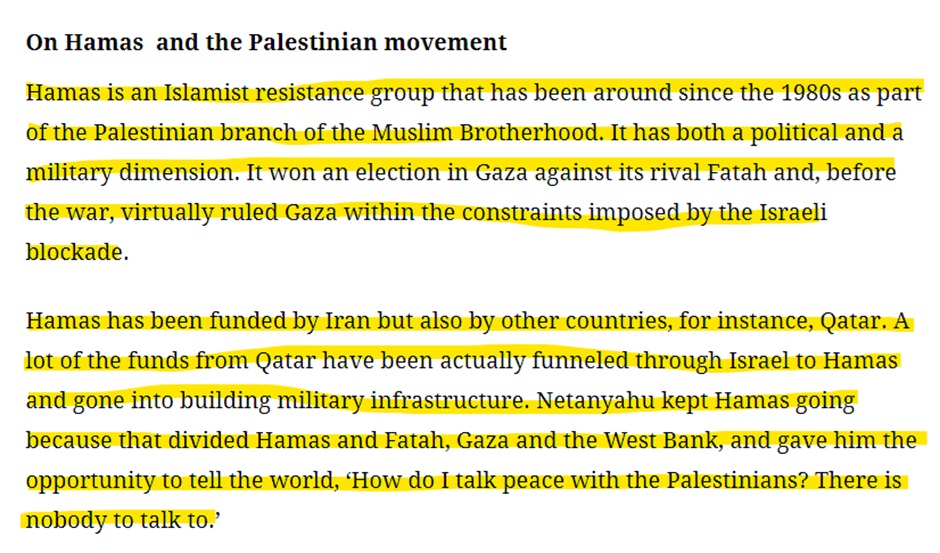
- Hamas is an Islamist resistance group that has been around since the 1980s as part of the Palestinian branch of the Muslim Brotherhood. It has both a political and a military dimension. It won an election in Gaza against its rival Fatah and, before the war, virtually ruled Gaza within the constraints imposed by the Israeli blockade.
- The US has taken its eye off the Israel-Palestinian peace process for several years now. President Joe Biden has worked on an outside-in approach — let’s normalise Israel-Saudi Arabia, let’s normalise Israel-UAE, Bahrain, stress on economic development, and the Palestinian problem will either go away or get minimised. But this was an illusion.
- One belief is that Hamas decided to become the flagbearer of Palestinian resistance — since Fatah or the Palestinian Authority had become so weak and reportedly so corrupt that it lost the people’s trust and was seen as contractors of the Israeli state.
On international response to Israel
- Unfortunately, Israel thought the only way it could get Hamas was to pummel Gaza into rubble. Given the topography, population density, and the fact that Gaza is closed, people had nowhere to flee.
- One estimate says that the total tonnage of bombs dropped on Gaza was like three nuclear bombs. The Israelis claimed the civilian casualties were necessary to get to Hamas, who were in the tunnels.
- But then the jury came out on whether this crosses Geneva Convention definitions of proportionality in terms of loss of civilian life, dual-use targeting, targeting of humanity. And the support for Israel began to unravel.
On how this situation impacts India
- If there is instability in the Middle East, it has obvious implications for India.
- If there is instability between Israel and Iran, if the Houthis are attacking ships in the Red Sea, it has implications for us.
- Conflict is not in our interest. India has to take care of its interests, and contribute towards the restoration of peace and security. Much of it is now beyond any one country’s doing. We have to keep our channels open with everybody there.
On the two-state solution and its future
- This two-state solution was almost buried and now it has been exhumed. This is unfortunate because if you go back to the Peel Commission of 1937 or the UN Partition Plan or the UN resolution 181 or the Oslo process, this seems to have been the only solution.
- Through the years, countries, the UN have paid lip service to the two-state solution. Things have happened that have made the two-state solution impossible — whether it’s a weak and allegedly corrupt Palestinian Authority, the division between Hamas and Fatah or the intense settler activity in the West Bank that is taking away from the concept of land for peace. All this, coupled with the move towards the Right in Israel politics over the last 10-15 years and the sidelining of the Israeli Left, means there has been no movement towards the two-state solution.
- After this conflict, it has become a rhetorical push again. At present, the Israelis are in no mood to have a Palestinian state on their border. And the Palestinians are not convinced about anybody who can deliver this two-state solution to them, because they feel as vulnerable about Israel being in the neighbourhood as the Israelis are about Palestinians. It’s a good thing to keep it as a long-term aspiration but I would not hold my breath that this is going to happen very quickly.