
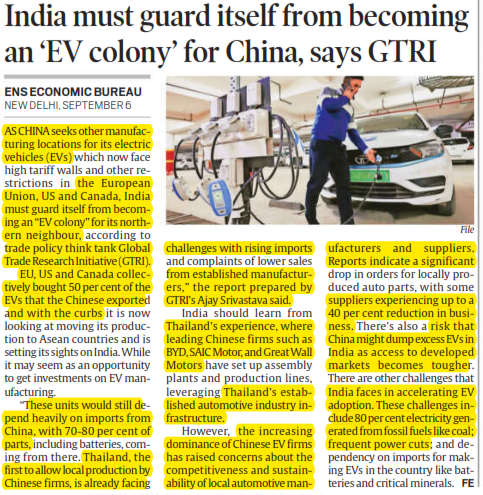
India must guard itself from becoming an EV colony for China says GTRI
- GTRI also said the global EV market is undergoing a seismic shift, driven by the US, EU, and Canada imposing high tariffs and restrictions on imports of EVs and parts from China
Highlights:
- On September 6, 2024, the Global Trade Research Initiative (GTRI) suggested that India should allow its domestic electric vehicle (EV) sector to grow organically without relying heavily on incentives.
- The think tank warned that over-reliance on external support could risk India becoming an "EV colony" for China.
Challenges in India's EV Adoption:
- Dependence on fossil fuels: 80% of India’s electricity is generated from coal.
- Power instability: Frequent power cuts hinder EV infrastructure development.
- Reliance on imports: India imports a significant portion of components needed to manufacture EVs, especially batteries and critical minerals.
Global Shifts in the EV Market:
- The global EV landscape is undergoing significant changes, driven by the US, EU, and Canada imposing high tariffs and restrictions on Chinese EVs and their components.
- These regions account for about half of China's EV exports. In response, China is shifting its production to ASEAN countries and looking at India as a potential market.
- GTRI warned that although Chinese firms might set up production units in India or ASEAN nations, these factories would still depend on Chinese imports for 70-80% of components, particularly batteries.
- Thailand, which allowed local production by Chinese firms, is already facing challenges such as rising imports and declining sales for established manufacturers.
Risk of Dumping in India:
- There is a risk that China could dump excess EVs in India as access to developed markets becomes more restricted. India, therefore, must be cautious about becoming a dumping ground for surplus Chinese EVs.
Recommendations for India's EV Sector:
- GTRI proposed that India focus on long-term leadership in the global EV sector by investing in future technologies. Key recommendations include:
- Investment in R&D: Prioritize the development of next-generation batteries and battery recycling infrastructure.
- Clean energy sources: Promote renewable energy to power EV charging stations.
Structural Changes in the Global EV Market:
- Hi-Tech Gears Chairman Deep Kapuria highlighted several trends impacting the global EV market, including:
- Subsidies and incentives: Many countries are offering subsidies and tax benefits to promote EV adoption.
- Critical mineral availability: The supply of essential minerals like lithium, cobalt, and nickel plays a crucial role in the growth of the EV industry.
Prelims Takeaways:
- Global Trade Research Initiative (GTRI)
- ASEAN