
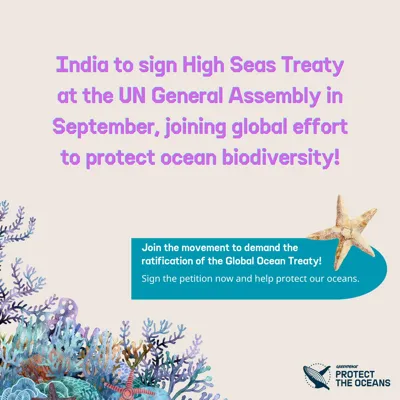
India Joins Global Efforts by Signing the High Seas Treaty
| Aspect | Details |
|---|---|
| Event | India signs and ratifies the High Seas Treaty (BBNJ Agreement). |
| Announcement | Made by Science and Technology Minister Jitendra Singh on July 2, 2024. |
| Purpose of Treaty | To protect and conserve biodiversity in oceans beyond national jurisdictions. |
| Comparison | Compared to the 2015 Paris Agreement in scope and impact. |
| High Seas Definition | Ocean areas outside national boundaries, covering 64% of the ocean surface. |
| Governance | Regulated by UN Convention on the Law of the Seas (UNCLOS). |
| Key Provisions | 1. Marine Protected Areas2. Equitable Sharing of Benefits3. Environmental Impact Assessments |
| Marine Protected Areas | Designated areas where activities like deep-sea mining are prohibited or regulated. |
| Equitable Sharing | Benefits from ocean life forms (e.g., drug development) to be shared globally without IP rights. |
| Environmental Assessments | Required for commercial activities likely to cause large-scale pollution. |
| Implementation Process | Treaty becomes law 120 days after 60 countries ratify it. |
| Current Status (Sep 2024) | 91 countries signed, 8 countries ratified. |