
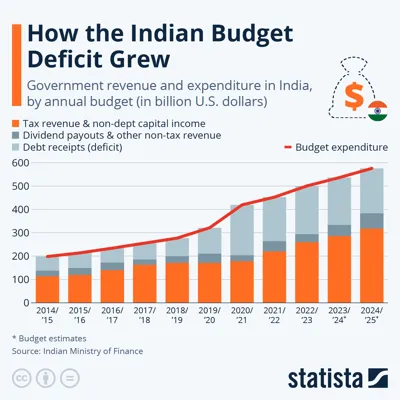
Understanding the Indian Government Budget: Key Concepts and Constitutional Mandates
| Topic | Details |
|---|---|
| Definition of Budget | A government's annual financial statement outlining income and spending for the year. Acts as a tool for resource management, funding projects, and ensuring economic stability. |
| Constitutional Basis | - Term 'Budget' not explicitly mentioned; referred to as 'Annual Financial Statement' (Article 112).- Article 265: Taxation requires parliamentary approval.- Article 266: Expenditure requires parliamentary approval. |
| FRBM Act (2003) | Aims at better budget management. Mandates presentation of fiscal policy documents alongside the Budget, including Macro-economic Framework, Fiscal Policy Strategy Statement, and Medium-Term Fiscal Policy. |
| Budget Documents | - Constitutionally Mandated: Annual Financial Statement, Demands for Grants, Appropriation Bill, Finance Bill.- FRBM Act Mandated: Macro-economic framework, Fiscal Policy Strategy, etc. |
| Railway Budget Integration | Merged with Union Budget in 2017. Railway figures now included in the Annual Financial Statement. |
| Union Budget Presentation | Presented on February 1 since 2017. Preceded by Economic Survey on January 31. In election years, presented twice: Vote on Account first, followed by full Budget. |
| Vote on Account | Used when full budget cannot be approved before the new financial year. Provides funds for government operations for a limited period, usually two months. |
| Budget Speech | Delivered by Finance Minister in two parts:- Part A: General economic survey.- Part B: Taxation proposals. Annual Financial Statement presented at the conclusion. |
| Economic Survey | Presented a day before the Budget (January 31). Provides an overview of the country's economic status. |
| Parliamentary Process | Budget discussions follow presentation, ensuring transparency and accountability in financial matters. |