
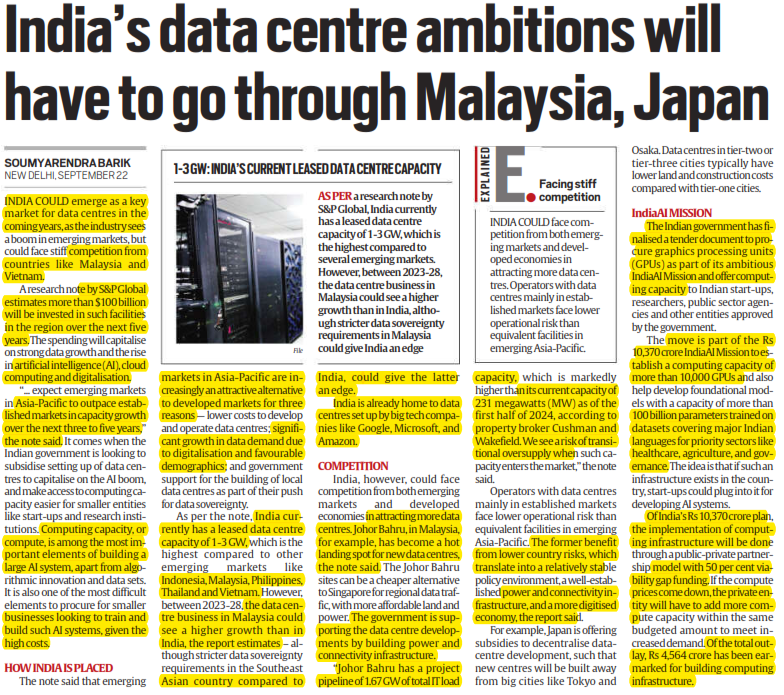
India's data centre ambitions will have to go through Malaysia, Japan
- India could emerge as a key market for data centres in the coming years, as the industry sees a boom in emerging markets, but could face stiff competition from countries like Malaysia and Vietnam.
Highlights:
- India is poised to emerge as a significant market for data centres in the Asia-Pacific region, thanks to its booming digital economy, AI growth, and cloud computing demand. However, competition from both emerging and developed markets, such as Malaysia and Vietnam, could challenge India's dominance in this sector.
Key Drivers for India's Data Centre Growth:
- Growing Data Demand: With the rise of artificial intelligence (AI), cloud computing, and digitalisation, there is an increasing need for robust data infrastructure. India’s large population, rapid digital adoption, and favourable demographics make it a prime location for data centres.
- Government Support: The Indian government has taken steps to subsidise data centre setups to address the high costs associated with computing capacity. Initiatives like the IndiaAI Mission aim to provide access to affordable computing power for start-ups and research institutions.
- This support positions India as a potential leader in the region’s data centre landscape.
- Existing Tech Infrastructure: India is already home to data centres operated by major technology companies like Google, Microsoft, and Amazon, providing a foundation for further expansion.
Competitive Landscape:
- Despite India’s potential, competition is fierce. Malaysia and Vietnam are emerging as attractive alternatives for data centre operators due to lower operational costs and significant government backing.
- For example, Johor Bahru in Malaysia is gaining traction as a cheaper alternative to Singapore, offering more affordable land and power for regional data traffic.
- Moreover, operators in developed markets like Japan and Singapore face lower country risks, which result in a stable policy environment and well-established power and connectivity infrastructure.
- Japan, for instance, is offering subsidies to decentralise data-centre development into smaller cities, helping reduce costs.
India’s Edge: Data Sovereignty and Market Size:
- India’s advantage lies in its relatively lenient data sovereignty laws compared to stricter regulations in Southeast Asia.
- This gives India an edge for companies seeking greater flexibility in data storage and transfer. Additionally, India’s massive market size, with a leased data centre capacity of 1-3 GW, is larger than most other emerging markets in the region.
IndiaAI Mission and GPU Infrastructure:
- The Indian government’s IndiaAI Mission, with a budget of Rs 10,370 crore, includes plans to establish computing capacity with over 10,000 GPUs.
- This initiative aims to support the development of foundational AI models in key sectors such as healthcare, agriculture, and governance.
- The public-private partnership model, with viability gap funding, ensures private companies have incentives to build more capacity as demand increases.
Challenges and the Way Forward:
- India faces challenges such as transitional oversupply risks and policy volatility compared to developed markets.
- However, with the government's focused efforts on building infrastructure and compute capacity, and the backing of global tech giants, India is well-positioned to solidify its role as a leading data centre hub in the region.
Prelims Takeaways:
- IndiaAI Mission