
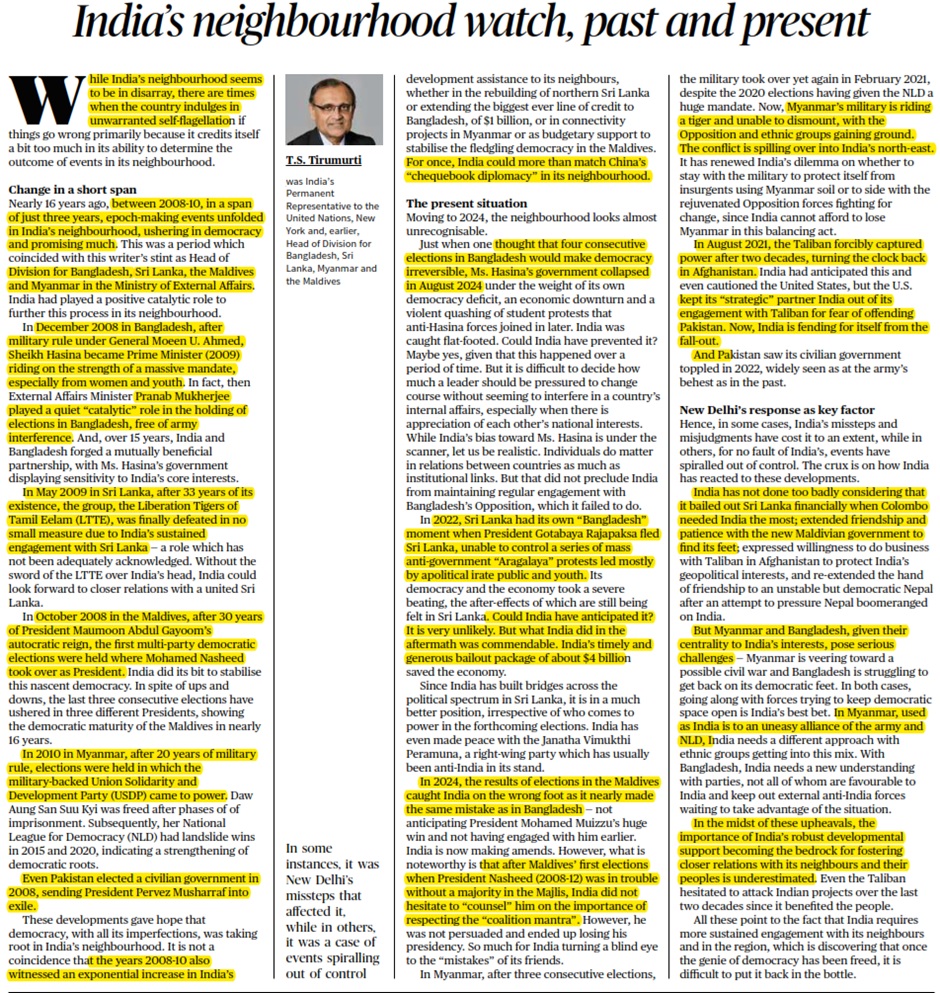
India’s neighbourhood watch, past and presen
- India’s neighbourhood has witnessed significant political transformations over the past two decades, marked by shifts towards democracy, economic turmoil, and periodic crises.
- India, as a regional power, has played a pivotal role in influencing these transitions, often acting as a catalyst for democracy and stability.
- However, the evolving political landscape has posed challenges to India's foreign policy and its ability to shape outcomes in its neighbourhood.
Positive Role in Neighboring Democracies (2008-2010):
- Bangladesh (2008): Transition from military rule to the election of Sheikh Hasina as Prime Minister, with significant electoral support particularly from women and youth. India's role in ensuring elections free from military interference is noted.
- Sri Lanka (2009): The defeat of the Liberation Tigers of Tamil Eelam (LTTE), facilitated closer ties between India and a united Sri Lanka.
- Maldives (2008): The first multi-party democratic elections led to Mohamed Nasheed's presidency, with India supporting the stabilization of this democracy.
- Myanmar (2010): Transition from military rule to a civilian government led by the Union Solidarity and Development Party (USDP), and later significant electoral victories for Aung San Suu Kyi's National League for Democracy in 2015 and 2020.
- Pakistan (2008): Election of a civilian government, marking a shift from military-led governance.
Economic and Democratic Crises (2022-2024):
- Bangladesh (2024): Collapse of Sheikh Hasina's government amid economic downturns and political unrest, questioning India's anticipatory and responsive actions.
- Sri Lanka (2022): President Gotabaya Rajapaksa fled amid massive protests; India responded with a significant bailout package to aid the economic crisis.
- Maldives (2024): Unexpected electoral results challenged India's engagement strategies with emerging political figures.
- Myanmar (2021): Return of military rule despite democratic elections, complicating India's regional strategy and impacting its northeastern regions.
- Afghanistan (2021): Takeover by Taliban post-U.S. withdrawal, affecting India's strategic position and engagement in the region.
Impact on Regional Stability
- The fluctuating political and economic conditions in India's neighbourhood impact regional stability, affecting everything from cross-border security to economic collaborations.
- The shifts towards or away from democracy in countries like Bangladesh, Myanmar, and the Maldives influence the broader geopolitical dynamics and India's strategic interests.
Future Diplomatic Strategies:
- Fostering stronger institutional ties,
- Increasing economic assistance
- Supporting democratic resilience in its neighbourhood.
- Proactively managing relations with both ruling parties and oppositions,
- Enhancing regional cooperation frameworks,
- Addressing security concerns through multilateral engagements.
Conclusion and Way Forward
- The region's instability highlights the need for India to maintain and enhance its engagement to support democratic processes and economic stability.
- The ongoing shifts underscore the importance of India's role in promoting and sustaining regional democracy and addressing emerging crises proactively.