
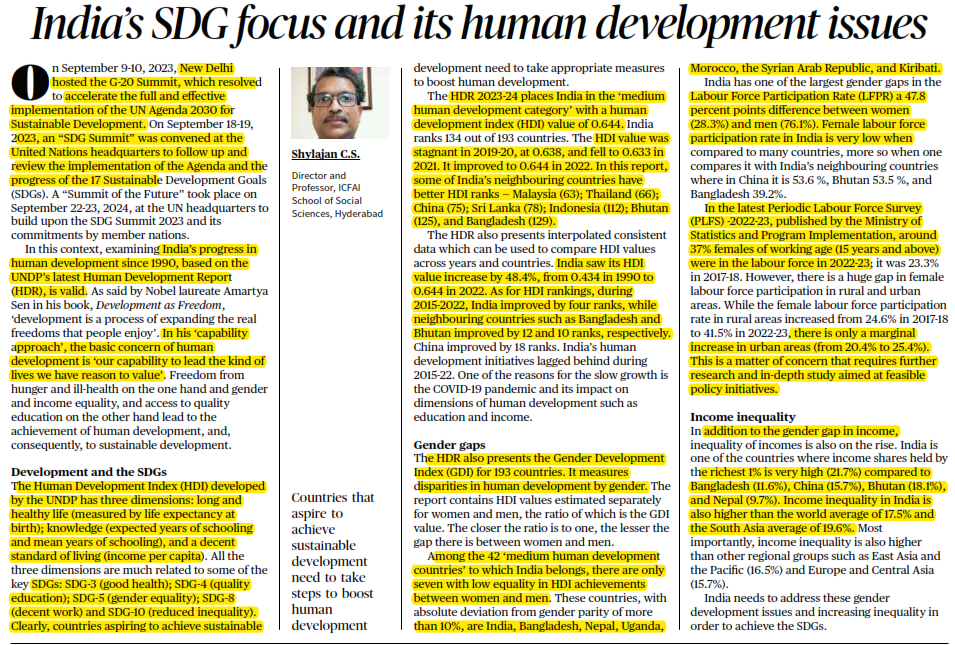
India’s SDG focus and its human development issues
- On September 9-10, 2023, New Delhi hosted the G-20 Summit, where leaders emphasized the need to accelerate the implementation of the UN Agenda 2030 for Sustainable Development.
- Shortly after, on September 18-19, the UN convened an SDG Summit to review progress on the 17 Sustainable Development Goals (SDGs). Building on these discussions, a “Summit of the Future” is scheduled for September 22-23, 2024, to further commitments made by member nations.
India's Human Development Progress:
- Reflecting on India's human development since 1990 is essential, particularly in light of the UNDP's latest Human Development Report (HDR). Nobel laureate Amartya Sen’s concept of development as the expansion of real freedoms emphasizes that human development is about enabling people to lead lives they value.
- Key elements, such as freedom from hunger and illness, gender equality, and access to quality education, are crucial for achieving sustainable development.
Human Development Index (HDI) Overview:
- The HDI comprises three dimensions: health (life expectancy), education (years of schooling), and standard of living (income per capita).
- These dimensions align closely with several key SDGs, including SDG-3 (good health), SDG-4 (quality education), SDG-5 (gender equality), SDG-8 (decent work), and SDG-10 (reduced inequality). Countries aiming for sustainable development must prioritize boosting human development metrics.
- According to the HDR 2023-24, India is categorized as having “medium human development,” with an HDI value of 0.644, ranking 134 out of 193 countries. While the HDI value improved from 0.633 in 2021 to 0.644 in 2022, it remains lower than that of many neighboring countries, such as Malaysia (63), Thailand (66), and China (75).
- Since 1990, India’s HDI has increased by 48.4%, rising from 0.434 to 0.644. However, from 2015 to 2022, India's HDI rank improved by only four positions, while neighboring countries like Bangladesh and Bhutan saw more significant gains.
Gender Disparities in Development:
- The HDR also evaluates gender disparities through the Gender Development Index (GDI), highlighting significant gaps in human development achievements between men and women.
- India, alongside a few other countries, exhibits one of the largest gender gaps in the Labor Force Participation Rate (LFPR), with only 28.3% of women participating compared to 76.1% of men—a difference of 47.8 percentage points.
- Recent data from the Periodic Labour Force Survey (PLFS) 2022-23 shows that while female labor force participation in rural areas rose significantly from 24.6% in 2017-18 to 41.5% in 2022-23, urban areas saw only a marginal increase from 20.4% to 25.4%. This disparity calls for further investigation and targeted policy initiatives.
Rising Income Inequality:
- Income inequality in India is a pressing issue, with the top 1% holding 21.7% of the nation’s income, significantly higher than in neighboring countries and above global averages. The rising income share of the richest contrasts sharply with averages in Bangladesh (11.6%), China (15.7%), and Nepal (9.7%). This high level of inequality undermines efforts to achieve the SDGs and is compounded by the overall rising trend in income disparity.
Conclusion
- To achieve the SDGs, India must address the intertwined issues of gender inequality and rising income disparities. Ensuring that all citizens can access the opportunities for health, education, and economic participation is crucial for sustainable development and the fulfillment of human potential.
- As India progresses, focused efforts on these fronts will be essential for a more equitable society and effective implementation of sustainable development goals.