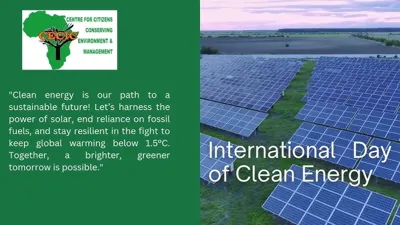
| Event | International Day of Clean Energy |
| Date | 26 January |
| Declared by | United Nations General Assembly (Resolution A/77/327) |
| Purpose | Raise awareness and mobilize action for a just and inclusive clean energy transition |
| Key Focus Areas | Energy poverty, climate change, renewable energy, energy efficiency |
| Energy Poverty | - 685 million people lack access to electricity (80% in Sub-Saharan Africa) - 1.8 billion people may rely on unsafe cooking practices by 2030 |
| Impact of Energy Poverty | - Hinders education, healthcare, and economic opportunities - Causes health risks from indoor air pollution |
| Climate Change | - Fossil fuels contribute significantly to greenhouse gas emissions - Transition to renewable energy is crucial to mitigate climate change |
| Renewable Energy Sources | Solar, wind, hydropower, geothermal, and waste |
| Benefits of Renewable Energy | - Environmental sustainability - Economic growth and job creation - Energy accessibility for remote areas |
| Energy Efficiency | - Reduces energy consumption and costs - Lowers carbon emissions - Expands access to affordable energy |
| SDG7 (Sustainable Development Goal 7) | - Aims for universal access to affordable, reliable, sustainable, and modern energy by 2030 - In 2022, 10 million more people lacked electricity due to population growth outpacing energy expansion |
| Challenges | - Scaling up renewable energy infrastructure - Providing financial and technical support to developing countries |
| Role of IRENA | - Established on 26 January 2009 - Provides data, policy recommendations, and platforms for international cooperation on renewable energy |