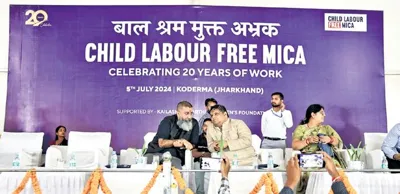
| Event | NCPCR declared mica mines of Jharkhand 'child labour-free' |
| Location | Koderma, Jharkhand |
| Announced by | Priyank Kanoongo, NCPCR Chairperson |
| Significance | First-ever successful endeavor to cleanse a supply chain of child labour in mica mining |
| Child Labour in India | Children up to 14 years of age classified as child labour |
| Mica Mining Background | Mica used in cosmetics, electronics, automobiles, and construction |
| Key Districts in Jharkhand | Koderma and Giridih |
| Historical Context | Mica mining booming industry, banned in 1980 due to Forest Conservation Act, leading to illegal mining |
| Child Labour in Mica Mining | Around 20,000 children employed at one point |
| Child Labour Free Initiative | Launched 20 years ago, involved state govt, district admin, village panchayats, civil society, central govt, and NCPCR |
| Implementation | Identified child labourers, removed them from mining, enrolled them in schools |
| NCPCR Establishment | Established in 2007 under CPCR Act, 2005 |
| NCPCR Mandate | Safeguards children's rights, ensures rights under RTE Act, 2009, and POCSO Act 2012 |
| NCPCR Composition | One chairperson and 6 members, including two women |
| Current NCPCR Chairperson | Priyank Kanoongo |
| Global Mica Production | China largest producer, India eighth-largest producer, largest exporter |
| Mica Production in India | Andhra Pradesh leads, followed by Rajasthan |
| Important Dates | NCPCR Founded: 5 March 2007 |
| NCPCR Headquarters | New Delhi, India |