
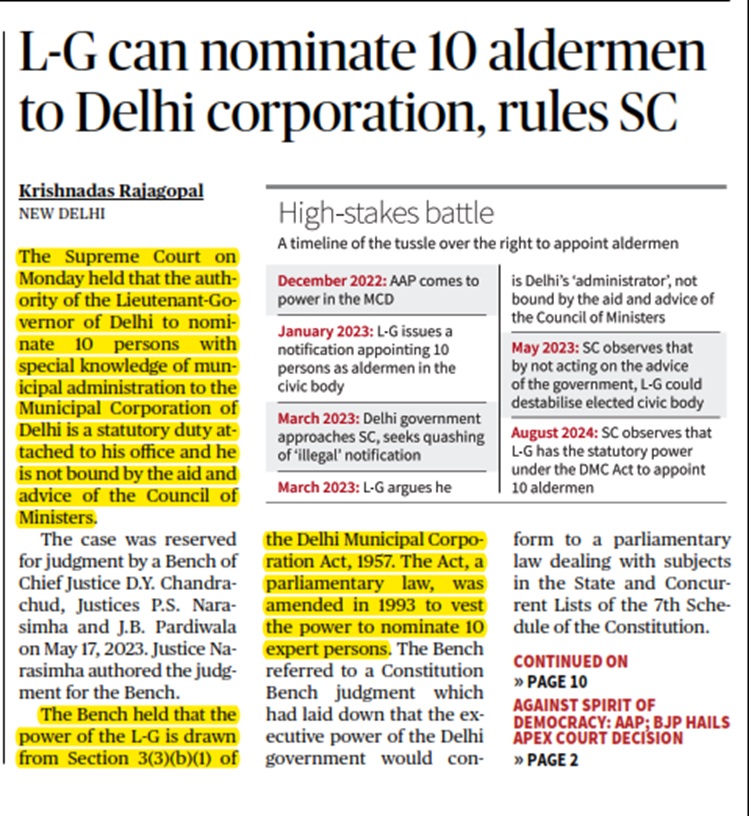
L-G can nominate 10 aldermen to Delhi corporation, rules SC
- The Supreme Court held that the authority of the Lieutenant Governor (L-G) of Delhi to nominate 10 persons to the Municipal Corporation of Delhi is a statutory duty
Highlights:
- The legal question before the court was whether the L-G could nominate the 10 persons as a part of the statutory duty of his office or was he bound by the aid and advice of the Council of Ministers.
- The court stated In this statutory duty the LG is not bound by the aid and advice of the Council of Ministers.
- The Bench held that the power of the L-G is drawn from Section 3(3)(b)(1) of the Delhi Municipal Corporation Act, 1957.
- The Act, a parliamentary law, was amended in 1993 to vest the power to nominate 10 expert persons.
- The two-judge Bench referred to a Constitution Bench judgment which had laid down that the executive power of the Delhi government would conform to a parliamentary law dealing with subjects in the State and Concurrent Lists of the Seventh Schedule of the Constitution.
- The statutory power under Section 3(3)(b)(1) to name the 10 persons of special knowledge was vested in the L-G for the first time through the 1993 amendments to the DMC Act, 1957 in order to incorporate constitutional changes in Articles 239AA and 239AB (provisions which deal with the establishment of the Delhi government) of the Constitution in Part 9A concerning municipal administration
- The power of the L-G to nominate is expressly given in the DMC Act, a parliamentary law.
Prelims Takeaway
- LG & his powers