
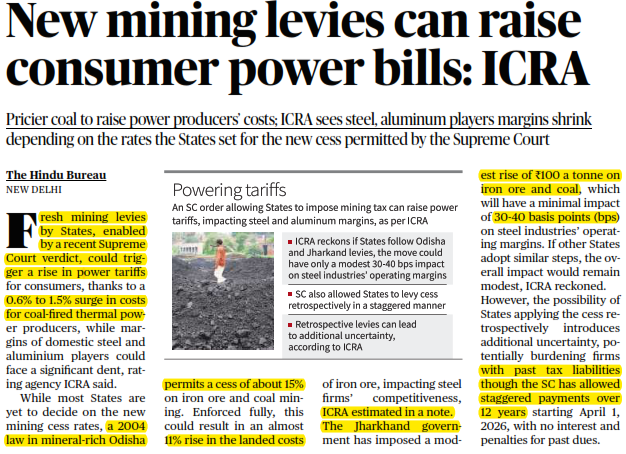
New mining levies can raise consumer power bills: ICRA
- Pricier coal to raise power producers’ costs; ICRA expects steel, aluminum players margins to shrink depending on the rates States fix for the new cess permitted by the Supreme Court
Highlights:
- The recent Supreme Court verdict enabling States to impose fresh mining levies is set to have far-reaching consequences for key industries in India, particularly those reliant on coal and iron ore.
- These new levies could lead to an increase in electricity tariffs for consumers and significantly impact the margins of domestic steel and aluminium producers.
- The potential effects of these levies have been analyzed by rating agency ICRA, which provides insights into the economic repercussions for various sectors.
Impact on Electricity Tariffs:
- The introduction of new mining levies is expected to cause a rise in the costs for coal-fired thermal power producers, ranging from 0.6% to 1.5%.
- This increase in costs will likely be passed on to consumers in the form of higher electricity tariffs.
- Coal-fired Thermal Power Producers: The surge in costs due to the new levies could lead to a proportional hike in electricity tariffs, making power more expensive for consumers.
- This could have broader economic implications, as higher electricity costs can affect industrial production and consumer spending.
- State-wise Variations: While most States have yet to finalize their mining cess rates, the implications could vary significantly depending on the rates imposed.
- For instance, Odisha, a mineral-rich state, has a 2004 law permitting a cess of around 15% on iron ore and coal mining. If fully enforced, this could result in an 11% increase in the landed cost of iron ore, further escalating costs for power producers.
Impact on Steel and Aluminium Industries:
- Steel Industry: The Jharkhand government's modest increase of ₹100 per tonne on iron ore and coal will have a relatively minor impact, reducing steel industry margins by 30 to 40 basis points.
- However, if other states adopt similar or higher levies, the impact could be more pronounced. Primary steel producers' margins could shrink by about 60 to 180 basis points, while secondary producers might see a more substantial decline of 80 to 250 basis points.
- Aluminium Industry: Aluminium producers are also expected to feel the squeeze, particularly due to the increased cost of power. Assuming a 15% cess, power costs for aluminium production could rise by ₹1,200-1,300 per tonne (approximately $15-$16 per tonne), representing around 0.6% of current aluminium prices.
Prelims Takeaways:
- ICRA