
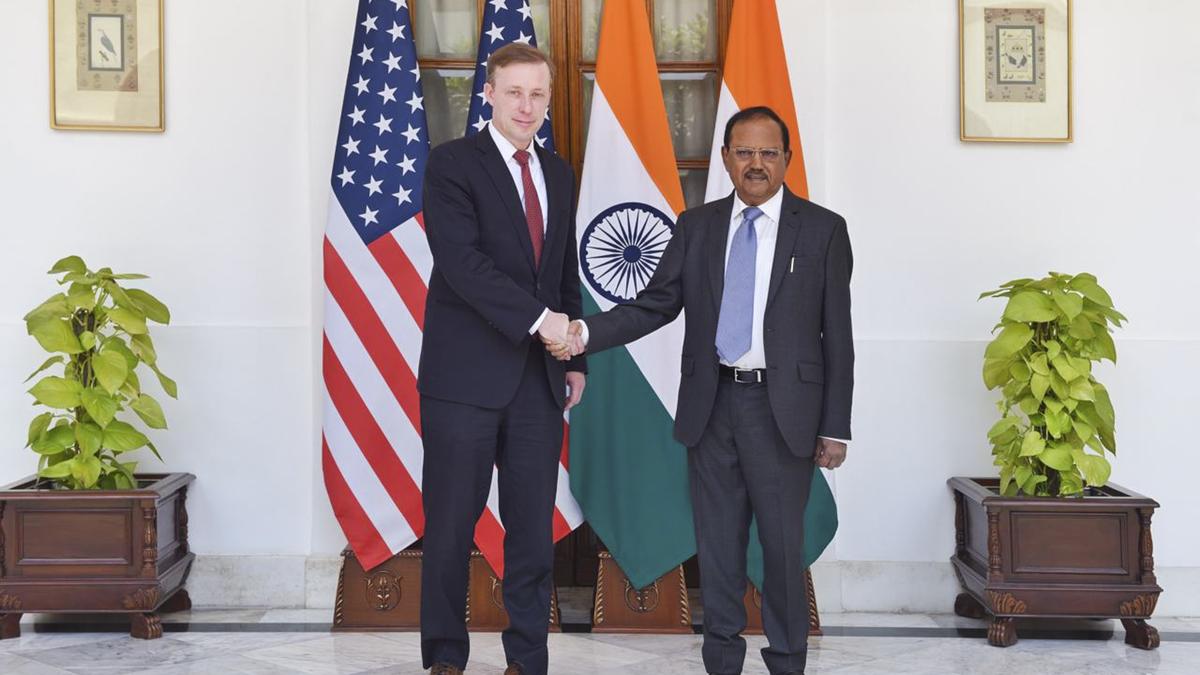
NSAs of India, U.S. review progress on iCET
- India’s National Security Adviser (NSA) and his U.S. counterpart, who is on a two-day visit to India, resolved to prevent the “leakage” of sensitive and dual-use technologies to countries of “concern” during the meeting of the initiative on Critical and Emerging Technology (iCET).
Highlights:
- The two NSAs set the vision for the next chapter of the strategic technology partnership, according to a joint fact sheet issued after the dialogue.
- They underscored their commitment to orienting our cooperation around breakthrough achievements in priority critical and emerging-technology areas,
- The India-U.S. iCET roundtable is scheduled with industry heads, organized by the Confederation of Indian Industry (CII).
- The India visit was canceled twice earlier due to geopolitical developments.
- India and the U.S. are currently in advanced stages for
- the purchase of 31 unmanned aerial vehicles and
- Manufacturing of General Electric jet engines as well as infantry vehicles,
- in the India-U.S. Roadmap for Defense Industrial Cooperation.
- On semiconductors, a priority area for both countries,
- Announced the launch of a new strategic semiconductor partnership between General Atomics and Indian firm 3rdiTech
- The Co-development of semiconductor design and manufacture of precision-guided ammunition and other national security-focused electronics platforms.
- Also outlined several steps both countries would take in new and emerging areas which in a large way would also address dependency on China.
- On rare-earth minerals, “Promoting India’s vital role in the Mineral Security Partnership, including through co-investing in a lithium resource project in South America and a rare earths deposit in Africa, to diversify critical mineral supply chains.
- The ambitious iCET was announced by India’s PM and U.S. President on the sidelines of the Quad Summit in Tokyo in 2022 and was launched by the NSAs in 2023 comprising key technology sectors including space, semiconductors, advanced telecommunications, artificial intelligence, quantum science, biotechnology, and clean energy.
- Subsequently, new areas were included including biotechnology, critical minerals and rare earths processing technologies, digital connectivity, digital public infrastructure and advanced materials.
Prelims Takeaway:
- India- US Relations
- Quad