
RBI buys 32.63 tonnes of gold in first half of FY25
- Central banks generally accumulate gold as part of the de-dollarisation process, leading to a jump in the price of the yellow metal. The strategy is to diversify their portfolios.
Highlights:
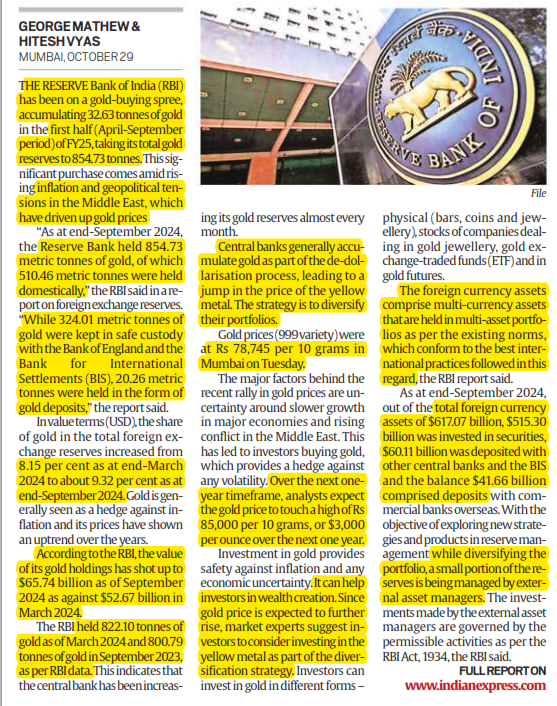
- The Reserve Bank of India (RBI) acquired 32.63 tonnes of gold from April to September 2024, increasing its total gold reserves to 854.73 tonnes.
- This increase comes amid rising inflation and geopolitical tensions, particularly in the Middle East, contributing to a rise in gold prices.
- The RBI’s gold is valued at $65.74 billion as of September 2024, up from $52.67 billion in March 2024, making up 9.32% of India’s total foreign exchange reserves.
Distribution and Storage of Gold Reserves:
- Out of the 854.73 tonnes, 510.46 tonnes are stored domestically, while 324.01 tonnes are held with the Bank of England and the Bank for International Settlements (BIS).
- An additional 20.26 tonnes are held as gold deposits.
Strategic Role of Gold Accumulation:
- Central banks worldwide, including the RBI, are purchasing gold as part of a “de-dollarisation” strategy to diversify reserves and mitigate risks related to the U.S. dollar.
- Gold is considered a hedge against inflation and economic volatility, providing portfolio security in uncertain times.
Rising Gold Prices and Investment Outlook:
- Recent market volatility and geopolitical instability have driven investors toward gold, with prices in India reaching ₹78,745 per 10 grams and predictions to hit ₹85,000 per 10 grams (or $3,000 per ounce) over the next year.
- Experts recommend gold investment as a diversification strategy, available in forms like physical gold, gold ETFs, gold stocks, and gold futures.
Foreign Currency Assets and Reserve Management:
- As of September 2024, India’s foreign currency assets amounted to $617.07 billion, with investments in securities, central bank deposits, and commercial bank deposits overseas.
- The RBI manages a portion of these reserves through external asset managers in line with the RBI Act, 1934, for greater portfolio diversification.
Reserves and Debt Coverage:
- By June 2024, the foreign exchange reserves provided 11.2 months of import cover, slightly lower than 11.3 months in March 2024.
- The short-term debt-to-reserves ratio rose from 19.7% in March 2024 to 20.3% in June 2024, while the ratio of volatile capital flows to reserves increased slightly from 69.8% to 70.1%.
Prelims Takeaways
- Bank for International Settlements (BIS)
- exchange-traded funds