
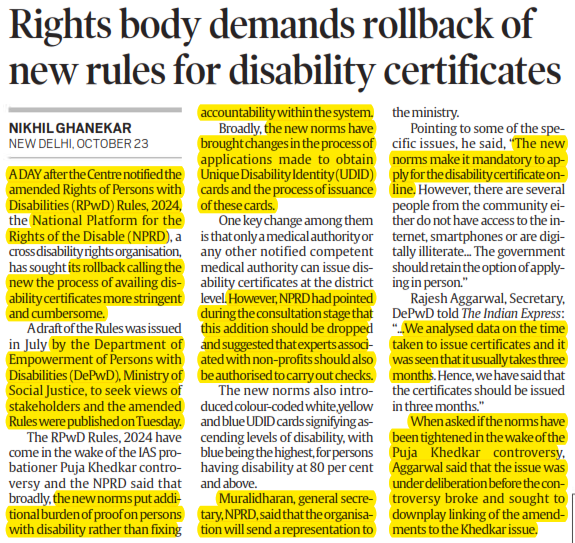
Rights body demands rollback of new rules for disability certificates
- A day after the Central Government notified the amended Rights of Persons with Disabilities (RPwD) Rules, 2024, the National Platform for the Rights of the Disabled (NPRD), a cross disability rights organisation.
Highlights:
- The Central Government recently notified the amended Rights of Persons with Disabilities (RPwD) Rules, 2024. The National Platform for the Rights of the Disabled (NPRD) has called for their rollback, criticizing the new rules for making the process of availing disability certificates more difficult.
Context and Changes:
- The new RPwD Rules follow the IAS probationer Puja Khedkar controversy, in which Khedkar was dismissed for alleged forgery of disability and caste certificates. The NPRD argues that the amended rules place additional burdens on persons with disabilities, rather than fixing systemic accountability.
Key changes include:
- Only medical authorities can issue disability certificates at the district level.
- Introduction of color-coded UDID cards: white, yellow, and blue, with blue indicating 80% disability and above.
NPRD’s Concerns:
- NPRD opposes these changes, stating they add hurdles for genuine individuals with disabilities, complicating the process of obtaining essential certification for services and entitlements. They also argue that the new rules fail to address the systemic flaws exposed in the Puja Khedkar case.
Mandatory Online Applications:
- One specific issue raised by NPRD is the mandatory requirement to apply online for disability certificates. They highlighted that many disabled individuals lack internet access, smartphones, or digital literacy, making the process inaccessible for them. Additionally, the requirement to state specific technical terms for disabilities further complicates applications for some.
Lack of Consideration for Stakeholder Suggestions
- NPRD expressed frustration that their recommendations, submitted in August, were ignored. One significant concern was the extension of the time limit for issuing certificates from one to three months, which NPRD finds unnecessary.
Government’s Response
- Rajesh Aggarwal, Secretary of the Department of Empowerment of Persons with Disabilities (DePwD), responded by stating that the amendments aim to simplify the certification process and align it with data showing that issuing certificates typically takes three months.
- He downplayed any link between the new rules and the Puja Khedkar case, stating that these deliberations were already underway prior to the controversy.
NPRD’s Next Steps
- NPRD plans to send a formal representation to the Ministry of Social Justice, urging the government to reconsider the new rules, particularly the mandatory online application requirement and the extended timeframe for certificate issuance. They stress the need for a more inclusive, accessible, and user-friendly system for persons with disabilities.
Prelims Takeaways:
- Unique Disability Identity (UDID)
- National Platform for the Rights of the Disabled (NPRD)