
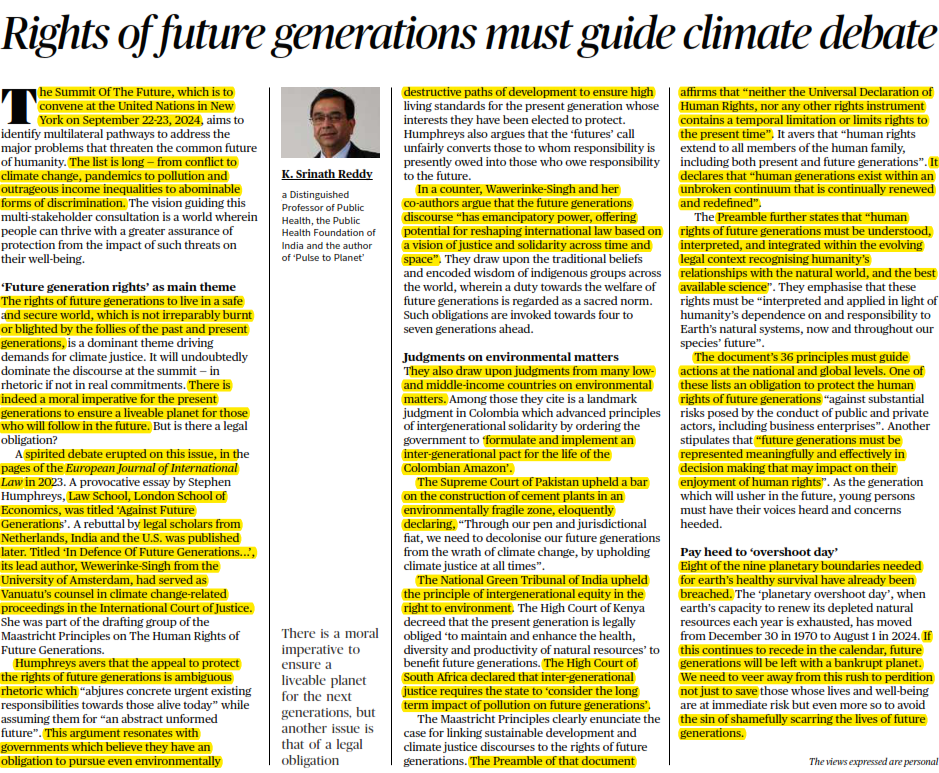
Rights of future generations must guide climate debate
- The Summit of the Future, set for September 22-23, 2024 at the United Nations in New York, brings together global leaders to address the multilateral challenges threatening humanity's collective future.
- Key issues include climate change, conflict, pandemics, pollution, and economic inequalities, with a guiding vision for a world where people are protected from these threats.
Rights of Future Generations: Moral vs. Legal Imperative:
- A central theme in this summit is the rights of future generations to inherit a safe, secure world, unscarred by the actions of current generations.
- The concept of climate justice has drawn attention to the moral duty of current generations to protect the environment for the future. However, a contentious debate arises over whether this responsibility constitutes a legal obligation.
- A 2023 debate in the European Journal of International Law framed the discussion. Stephen Humphreys from the London School of Economics argued against future generations' rights, suggesting that such rhetoric detracts from addressing current urgent responsibilities.
- In contrast, Wewerinke-Singh and co-authors argued in defense of these rights, emphasizing that intergenerational justice offers an opportunity to reshape international law for justice and solidarity across time.
Legal Precedents and Judicial Support:
- Legal systems worldwide have supported the principle of intergenerational justice in environmental matters. Landmark judgments from Colombia, Pakistan, India, and Kenya uphold the obligation to protect the environment for future generations.
- Courts have declared a responsibility to prevent climate damage, promote climate justice, and safeguard natural resources.
- For example, the Supreme Court of Pakistan emphasized the need to shield future generations from climate change, while India's National Green Tribunal upheld the principle of intergenerational equity.
The Maastricht Principles: Legal Framework for Future Generations:
- The Maastricht Principles on the Human Rights of Future Generations lay out a strong legal framework. They assert that human rights extend across time and that future generations are entitled to protection from environmental harm caused by current public and private actors.
- These principles call for meaningful representation of future generations in decision-making processes that affect their rights and well-being.
A Global Crisis: Breaching Planetary Boundaries:
- Eight of the nine planetary boundaries essential for Earth's survival have already been breached, with the planetary overshoot day—when Earth’s annual renewable resource capacity is depleted—moving from December 30 in 1970 to August 1 in 2024.
- If this trend continues, future generations will inherit a planet in environmental bankruptcy.
Conclusion: Urgency for Action:
- As global leaders gather for the Summit of the Future, the focus must shift from mere rhetoric to real commitments. The rights of future generations must be legally recognized, and climate justice must become a core element of international law.
- Only through urgent and sustained action can we ensure that future generations are not condemned to live on a blighted planet, left vulnerable by the irresponsibility of the present.