
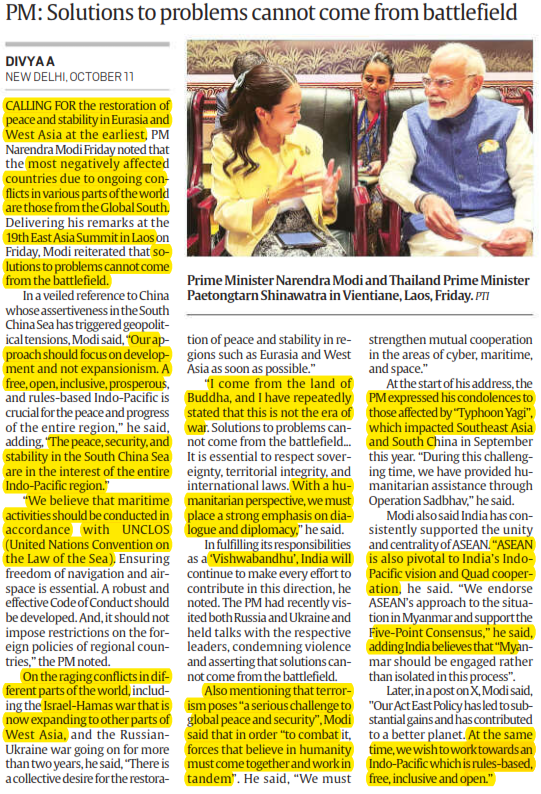
Should focus on development, not expansionism, says Modi
- Delivering his remarks at the 19th East Asia Summit in Laos on Friday, Modi reiterated that solutions to problems cannot come from the battlefield.
Highlights:
- At the 19th East Asia Summit held in Laos, Prime Minister Narendra Modi emphasized the urgent need to restore peace and stability in conflict-ridden regions, particularly in Eurasia and West Asia.
- He highlighted how countries from the Global South are the most negatively affected by these ongoing conflicts and called for diplomacy over military action.
The Call for Peaceful Solutions:
- No Solutions from the Battlefield: Modi reiterated that solutions to global problems should not come from warfare but through diplomacy. Referring to the teachings of Buddha, he stressed the importance of dialogue, diplomacy, and respect for sovereignty and international law in resolving conflicts.
- Global Conflicts: He addressed ongoing conflicts like the Israel-Hamas war and the Russia-Ukraine war, which have caused regional instability. Modi underscored the collective desire to restore peace in these regions.
Indirect Reference to China:
- Development vs. Expansionism: In a veiled reference to China, whose actions in the South China Sea have raised geopolitical tensions, Modi stressed the importance of focusing on development, not expansionism. He called for a free, open, inclusive, and rules-based Indo-Pacific region.
- South China Sea and Indo-Pacific: Modi emphasized that peace and security in the South China Sea are crucial for the Indo-Pacific region. He also stressed the importance of adhering to the United Nations Convention on the Law of the Sea (UNCLOS) and developing a Code of Conduct that respects the foreign policies of regional countries.
India’s Stance on Terrorism and Global Cooperation:
- Combatting Terrorism: Modi highlighted terrorism as a major challenge to global peace and called for countries that value humanity to unite against it. He emphasized the need for cooperation in areas like cybersecurity, maritime security, and space.
ASEAN and India's Act East Policy:
- India’s Support for ASEAN: Modi reaffirmed India’s support for ASEAN unity and centrality, emphasizing the importance of ASEAN in India’s Indo-Pacific vision. He endorsed ASEAN’s approach to the crisis in Myanmar and the Five-Point Consensus, advocating for engagement rather than isolation of Myanmar.
- Act East Policy: Modi reflected on the success of India’s Act East Policy, which has strengthened relations with Southeast Asian countries and contributed to global peace efforts.
Humanitarian Assistance and Final Remarks:
- Humanitarian Support: Modi extended his condolences to those affected by Typhoon Yagi, highlighting India's humanitarian assistance efforts through Operation Sadbhav.
- Vision for the Indo-Pacific: Modi reiterated India’s commitment to a free, open, and inclusive Indo-Pacific, aligning with the principles of the Quad and ASEAN.
Prelims Takeaways:
- United Nations Convention on the Law of the Sea
- Quad cooperation