
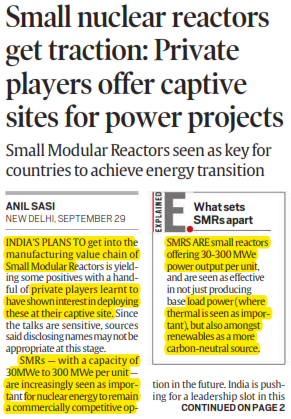
Small nuclear reactors get traction: Private players offer captive sites for power projects
- India’s plans to get into the manufacturing value chain of Small Modular Reactors is yielding some positives with a handful of private players learnt to have shown interest in deploying these at their captive site.
Highlights:
- India's plans to enter the manufacturing value chain of Small Modular Reactors (SMRs) are showing early promise, with several private players expressing interest in deploying these reactors at their captive sites. SMRs, with a capacity ranging from 30 MWe to 300 MWe per unit, are gaining importance as an innovative option for nuclear energy, particularly in meeting the growing global demand for clean energy.
India’s SMR Ambitions:
- India is aiming for a leadership role in the SMR technology space, not only to advance its own clean energy goals but also as a strategic tool in its foreign policy, positioning itself as a credible alternative in nuclear energy technology.
- This comes at a time when Russia and China, early leaders in SMRs, are facing difficulties in expanding their business beyond their borders.
Government Push and Private Sector Involvement:
- The Indian government is currently conducting detailed technical discussions on the feasibility and effectiveness of SMR deployment.
- This includes exploring the participation of private sector players and start-ups, something that is under consideration within the framework of the Atomic Energy Act, 1962.
- While traditional nuclear reactors have steadily increased in size—from earlier 220 MWe reactors to the latest 700 MWe pressurised heavy water reactors (PHWRs)—India has a solid track record in producing and operating small reactors.
- These are seen as a viable alternative, especially for countries with mid-sized grids or decentralised grid operations.
Global SMR Developments and India’s Role:
- Globally, two SMR projects have reached the operational stage: Akademik Lomonosov in Russia, a floating power unit with two modules of 35 MWe each, and HTR-PM in China, which became commercially operational in December 2023.
- India is positioning itself as a credible alternative in this space, leveraging its history of manufacturing reactors cost-effectively and at scale.
- SMRs offer significant advantages for grid operators by providing base load power, balancing the intermittency of renewable energy sources. This is critical in India’s energy transition strategy, where SMRs could play a key role in decarbonising industries.
Global Decline in Traditional Nuclear Energy:
- India’s SMR initiative comes at a time when the global nuclear sector is facing challenges. Nuclear power’s share in global electricity generation has declined, with countries like the United States, France, and Germany witnessing reductions in nuclear energy output.
- This decline has been driven by national policy shifts, economic viability concerns, and the rise of renewable energy alternatives.
- In contrast, SMRs present a more feasible option for many nations, particularly due to their smaller size, faster construction timelines, and lower upfront capital investment per reactor.
- Their modular nature allows them to be manufactured in a controlled factory environment and transported to project sites, reducing both costs and lead times compared to traditional large nuclear reactors.
Advantages of SMRs:
- Reduced Emergency Planning Zone: SMRs require smaller ring-fenced areas, making them suitable for more locations.
- Enhanced Safety: Their passive safety systems offer greater security compared to larger reactors.
- Potential for Repurposing: SMRs could repurpose decommissioned fossil-fuel plants.
- Cost-Effectiveness: Though capital investment per MW may initially be high, costs are expected to decrease with subsequent units.
- India's push into SMRs represents not only a step towards energy self-reliance but also a potential leadership position in global nuclear technology. As countries continue to look for low-carbon and flexible energy solutions, India's SMR capabilities could provide a competitive edge on the international stage.
Prelims Takeaways:
- Small Modular Reactors
- World Nuclear Industry Status Report
- Atomic Energy Act, 1962