
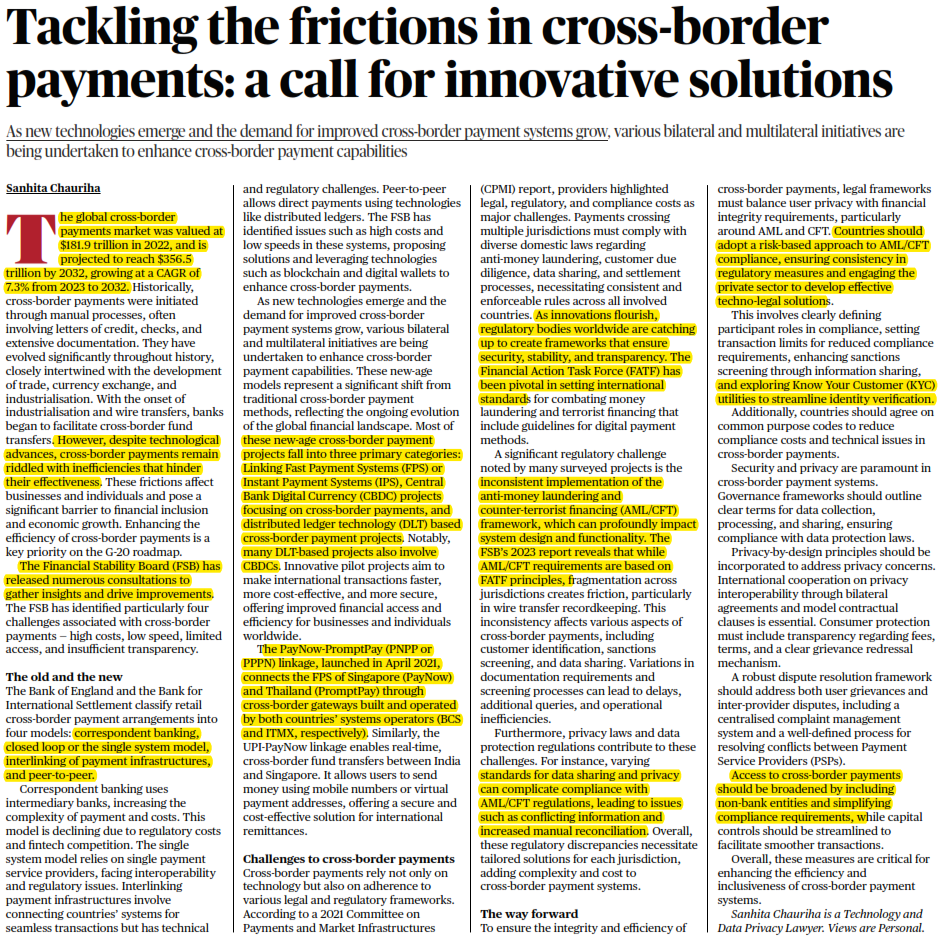
Tackling the frictions in cross-border payments: a call for innovative solutions
- The global cross-border payments market, valued at $181.9 trillion in 2022, is set to experience substantial growth, reaching $356.5 trillion by 2032.
- This rapid expansion underscores the increasing significance of efficient and secure cross-border transactions in a globally connected economy.
- However, despite technological advancements, the cross-border payments system is still plagued by inefficiencies that hinder economic growth and financial inclusion.
- Addressing these challenges requires a multifaceted approach encompassing technological innovations, regulatory reforms, and enhanced global cooperation.
The Evolving Landscape of Cross-Border Payments:
- Historically, cross-border payments involved cumbersome manual processes, including letters of credit and checks. With industrialization and technological advancements, methods like wire transfers emerged, making transactions faster and more reliable.
- Yet, traditional models—such as correspondent banking and closed-loop systems—continue to face issues related to high costs, slow speeds, and limited transparency.
- The Financial Stability Board (FSB) has identified these core challenges and proposed leveraging new technologies to enhance cross-border payment systems.
- The advent of distributed ledger technology (DLT), Central Bank Digital Currencies (CBDCs), and innovative payment linkages like PayNow-PromptPay and UPI-PayNow exemplify the shift towards more efficient and accessible payment mechanisms.
- These technologies promise to address the persistent issues of cost and speed, offering more secure and cost-effective solutions for international transactions.
Navigating Regulatory and Compliance Challenges:
- The need to comply with diverse domestic laws on anti-money laundering (AML) and counter-terrorist financing (CFT) introduces complexity and inefficiencies.
- The inconsistency in AML/CFT frameworks across jurisdictions, coupled with varying privacy laws, complicates compliance and operational efficiency.
- To overcome these challenges, it is crucial for countries to harmonize regulatory measures and adopt a risk-based approach to AML/CFT compliance.
- Clear roles and responsibilities in compliance, enhanced information sharing, and streamlined Know Your Customer (KYC) processes are essential for reducing friction and improving efficiency.
- Additionally, establishing common purpose codes and agreements on privacy interoperability can further ease compliance burdens and technical issues.
Ensuring Security and Inclusivity:
- Security and privacy are paramount in the evolution of cross-border payment systems. Governance frameworks must define data collection, processing, and sharing practices to align with data protection laws.
- Incorporating privacy-by-design principles and engaging in international cooperation for privacy interoperability are essential for addressing privacy concerns and ensuring robust consumer protection.
- A well-defined dispute resolution framework is also critical. It should address user grievances, inter-provider disputes, and include a centralized complaint management system to resolve conflicts effectively.
The Way Forward:
- The future of cross-border payments lies in balancing innovation with regulatory compliance. Embracing new technologies while addressing regulatory challenges through international cooperation and streamlined frameworks will be key to enhancing the efficiency and inclusiveness of global payment systems.
- As the market continues to expand, proactive measures to tackle existing inefficiencies and adapt to emerging trends will be crucial in realizing the full potential of cross-border payments.