
The Indian start-up at the heart of the country's first national security fab
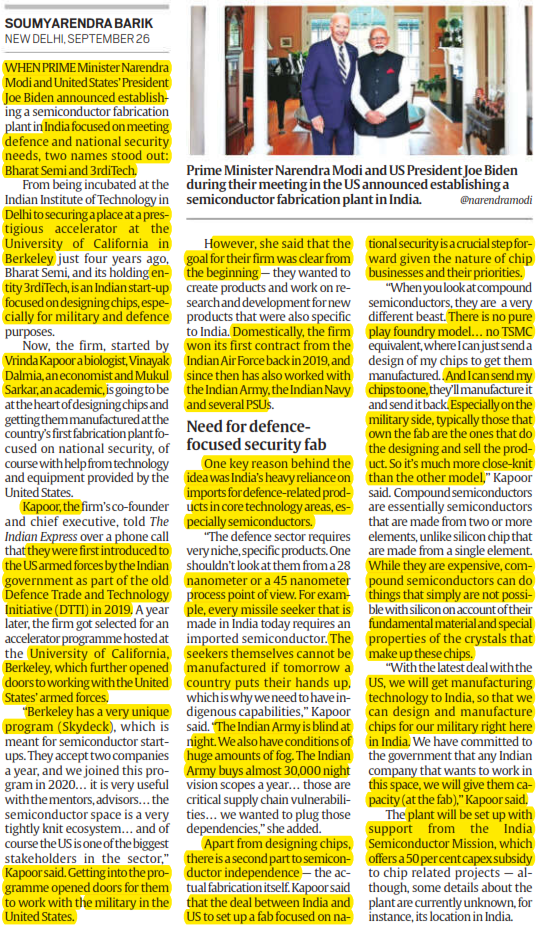
- When Prime Minister Narendra Modi and United States President Joe Biden announced establishing a semiconductor fabrication plant in India focused on meeting defence and national security needs.
Highlights:
- Prime Minister Narendra Modi and U.S. President Joe Biden announced the establishment of a semiconductor fabrication plant in India, focusing on defence and national security needs. Two key names associated with this project are Bharat Semi and 3rdiTech.
Bharat Semi and 3rdiTech: Indian Start-up Journey:
- Origin: Bharat Semi and its parent company, 3rdiTech, were incubated at the Indian Institute of Technology (IIT) Delhi and later secured a place at the prestigious Skydeck accelerator at the University of California, Berkeley in 2020.
- Focus: The start-up specializes in designing semiconductors for military and defence purposes, with a strong focus on creating India-specific products.
Founders:
- Vrinda Kapoor (Biologist), Vinayak Dalmia (Economist), and Mukul Sarkar (Academic) co-founded the company.
- Kapoor highlighted their collaboration with the U.S. armed forces, which began through India’s Defence Trade and Technology Initiative (DTTI) in 2019.
Goal of Bharat Semi:
- The firm’s primary objective has been to reduce India’s dependency on imports for critical defence technologies, particularly in the semiconductor space.
- For instance, India currently relies on imported semiconductors for manufacturing missile seekers and night vision scopes, both essential for defence purposes.
Key Milestones and Partnerships:
- Bharat Semi secured its first contract with the Indian Air Force in 2019 and has since collaborated with the Indian Army, Navy, and various Public Sector Undertakings (PSUs).
- Through the University of California’s accelerator, Bharat Semi gained entry into the U.S. semiconductor ecosystem, especially within the military sector.
India-U.S. Semiconductor Fabrication Deal:
- Kapoor explained that this deal is a significant step towards achieving semiconductor independence for India.
- Compound Semiconductors: The plant will manufacture compound semiconductors, which are made from two or more elements and possess superior properties compared to traditional silicon chips.
Challenges and Importance:
- Unlike the global model where companies send chip designs to be fabricated at foundries like TSMC, military-grade semiconductors often require closer integration between design and fabrication.
- The U.S. will provide India with manufacturing technology, enabling the production of semiconductors domestically for defence applications.
India Semiconductor Mission:
- The new fabrication plant will receive support through the India Semiconductor Mission, which offers a 50% capital expenditure subsidy for chip-related projects. Some details, such as the plant's exact location, remain undisclosed.
Prelims Takeaways:
- Defence Trade and Technology Initiative (DTTI)