
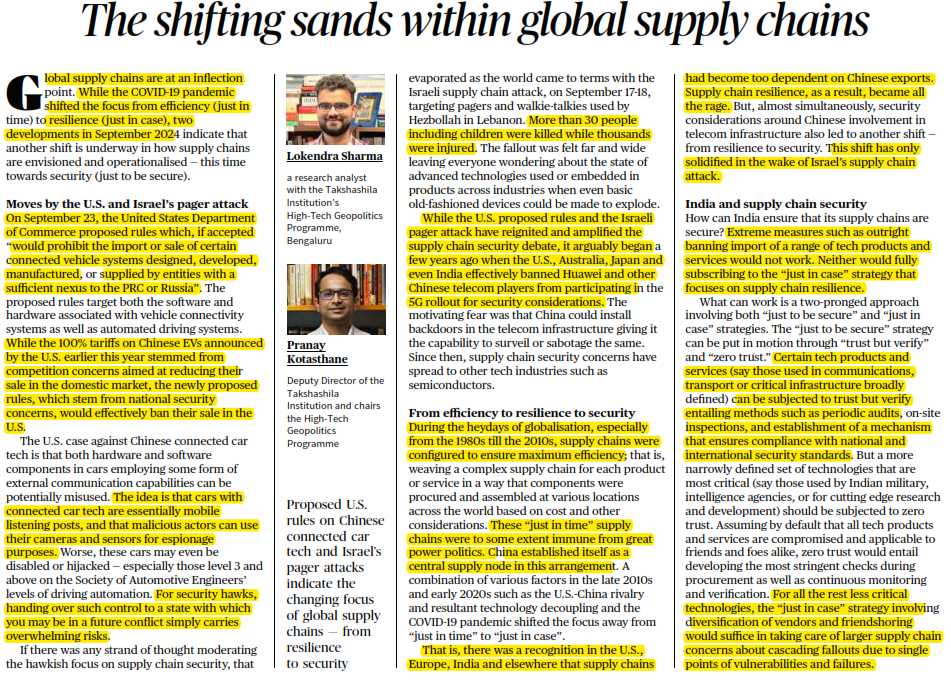
The shifting sands within global supply chains
- Global supply chains are experiencing a significant transformation. The COVID-19 pandemic initially shifted focus from efficiency ("just in time") to resilience ("just in case"). However, recent developments in September 2024 indicate a further shift towards security ("just to be secure").
U.S. Regulations and National Security Concerns:
- On September 23, the U.S. Department of Commerce proposed rules aimed at prohibiting the import or sale of certain connected vehicle systems linked to the People's Republic of China (PRC) or Russia.
- This proposal specifically targets software and hardware associated with vehicle connectivity and automated driving systems, effectively banning these technologies from the U.S. market based on national security concerns.
- The U.S. argues that vehicles equipped with connected technology could be exploited for espionage or even hijacked, particularly those with higher levels of automation.
Israeli Supply Chain Attack and Its Implications:
- Adding urgency to the conversation, an attack in Israel on September 17-18 targeted pagers and walkie-talkies used by Hezbollah, resulting in numerous casualties. This incident raised alarm about the vulnerabilities of advanced technologies, even within seemingly basic devices.
- Such attacks underscore the potential risks associated with embedded technologies across various industries, further fueling the debate on supply chain security.
A Historical Perspective: From Efficiency to Security:
- Historically, global supply chains prioritized efficiency, especially from the 1980s to the 2010s. Supply chains were designed to minimize costs, leveraging the global landscape for production and assembly.
- However, geopolitical tensions, particularly the U.S.-China rivalry, alongside the disruptions caused by the COVID-19 pandemic, shifted the focus from "just in time" to "just in case." Nations recognized their dependence on Chinese exports and began emphasizing supply chain resilience.
The Shift to Security Considerations:
- As security concerns surrounding Chinese telecom involvement emerged, the focus shifted again—from resilience to security. This was evident when several countries, including the U.S., Australia, Japan, and India, banned Huawei from participating in 5G networks, fearing potential backdoors for surveillance or sabotage.
India’s Approach to Supply Chain Security:
- Given these shifts, India faces the challenge of ensuring secure supply chains without resorting to extreme measures like blanket bans on imports. Instead, a two-pronged strategy that incorporates both “just to be secure” and “just in case” approaches is advisable.
- Just to be Secure: This strategy involves implementing a "trust but verify" approach alongside "zero trust" for critical technologies. Certain tech products, especially those related to communications and critical infrastructure, should undergo regular audits and inspections to ensure compliance with security standards.
- More sensitive technologies, particularly those used by the military or intelligence agencies, should adopt a zero trust model, assuming all products may be compromised and requiring stringent checks during procurement.
- Just in Case: For less critical technologies, a strategy focusing on vendor diversification and friendshoring can mitigate supply chain risks. This approach addresses concerns about vulnerabilities stemming from reliance on single sources, ensuring that supply chains remain resilient against potential disruptions.
Conclusion
- The ongoing evolution of global supply chains reflects a dynamic interplay of efficiency, resilience, and security. As nations navigate these changes, it is crucial for countries like India to adopt nuanced strategies that safeguard their interests while maintaining the flexibility to adapt to an increasingly complex global landscape.