
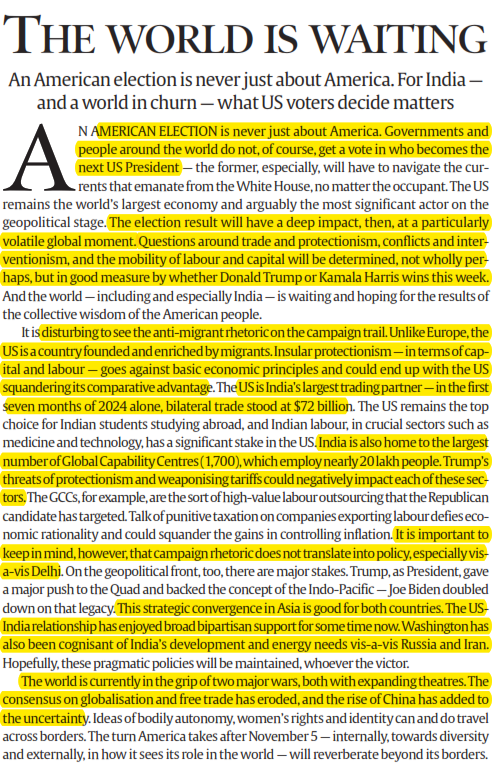
THE WORLD IS WAITING
- The American election holds global implications, influencing not only domestic policies but also international relations, trade, and geopolitical stability. The world, particularly India, watches closely, as the next U.S. President will inevitably shape policies that ripple across continents in an already volatile global landscape. Here are key aspects of how this election impacts global stakeholders, especially India:
Economic Impact:
- As the world’s largest economy, the U.S. directly influences global markets. Trade policies regarding tariffs, protectionism, and labor mobility could have significant implications. For India, the stakes are high, as it is the U.S.’s largest trading partner, with $72 billion in trade in 2024 so far.
- Campaign promises around protectionism and punitive taxation for labor outsourcing, especially by Trump, could potentially disrupt sectors critical to Indian interests, like technology, medicine, and the Global Capability Centers (GCCs) in India, which employ millions.
- Restrictive policies on labor could particularly impact Indian professionals and students seeking opportunities in the U.S., while harsher tariffs could affect Indian exports.
Geopolitical Stakes:
- In recent years, the U.S.-India relationship has deepened, with bipartisan support. Strategic alliances like the Quad and the Indo-Pacific vision are crucial for both nations, particularly as they counterbalance China’s influence in Asia.
- Both Trump and Biden administrations have fortified these strategic ties, with bipartisan acknowledgment of India’s importance in the region.
- Additionally, the U.S. has shown flexibility toward India’s relationships with Russia and Iran, considering its energy and defense needs, a pragmatic approach that India hopes the next administration will continue.
Migration and Social Issues:
- The U.S. is historically a nation built by immigrants, and campaign rhetoric around anti-immigration policies is unsettling, especially for a global workforce looking toward the U.S. for opportunities.
- Restricting migration contradicts basic economic principles by limiting labor flow, which could diminish the U.S.’s competitive edge. For India, whose professionals contribute significantly to sectors like healthcare and tech, restrictive migration policies would be detrimental.
- Similarly, issues around bodily autonomy, women’s rights, and identity in the U.S. resonate internationally and often influence social movements globally.
Global Stability and the Erosion of Globalization:
- The world is navigating two major conflicts and rising uncertainty as the consensus on globalization and free trade weakens. China’s ascendance further complicates this landscape, challenging U.S. and Western influence.
- The American stance on globalization, trade, and interventionism under the next administration could either restore or deepen these divides, impacting allies and trading partners worldwide.
The Broader Influence of U.S. Leadership:
- America’s internal trajectory toward diversity and global engagement will have widespread effects. Whether the U.S. continues to embrace its role as a proponent of global stability and integration, or turns inward, will send powerful signals globally.
- For India and other nations, there is hope for continuity in pragmatic policies that benefit both economic and geopolitical interests.