
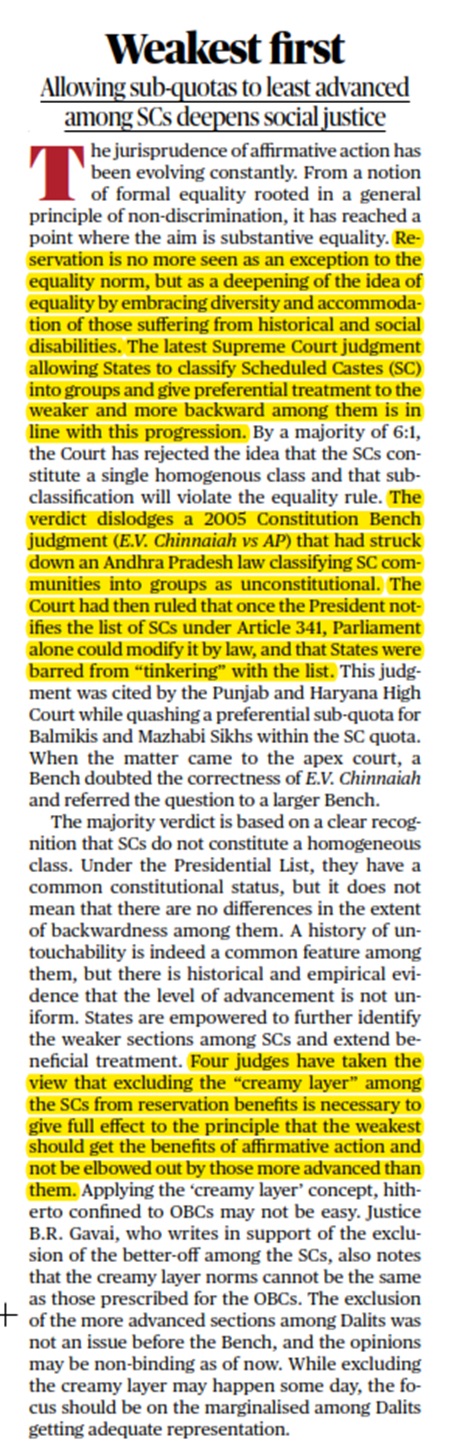
Weakest first
- Government Policies and Interventions for Development in various sectors and Issues arising out of their Design and Implementation.
Highlights:
- The jurisprudence of affirmative action has been evolving constantly.
- From a notion of formal equality rooted in a general principle of non-discrimination, it has reached a point where the aim is substantive equality.
- Reservation is no longer seen as an exception to the equality norm, but as a deepening of the idea of equality by embracing diversity and accommodation of those suffering from historical and social disabilities.
- The latest Supreme Court judgment allowing States to classify Scheduled Castes (SC) into groups and give preferential treatment to the weaker and more backward among them is in line with this progression.
- The majority verdict is based on a clear recognition that SCs do not constitute a homogeneous class.
- Under the Presidential List, they have a common constitutional status, but it does not mean that there are no differences in the extent of backwardness among them.
- A history of untouchability is indeed a common feature among them, but there is historical and empirical evidence that the level of advancement is not uniform.
- States are empowered to further identify the weaker sections among SCs and extend beneficial treatment.
- Four judges have taken the view that excluding the “creamy layer” among the SCs from reservation benefits is necessary to give full effect to the principle that the weakest should get the benefits of affirmative action and not be elbowed out by those more advanced than them.
- Applying the ‘creamy layer’ concept, hitherto confined to OBCs may not be easy.
- The exclusion of the more advanced sections among Dalits was not an issue before the Bench, and the opinions may be non-binding as of now.
- While excluding the creamy layer may happen some day, the focus should be on the marginalized among Dalits getting adequate representation.